

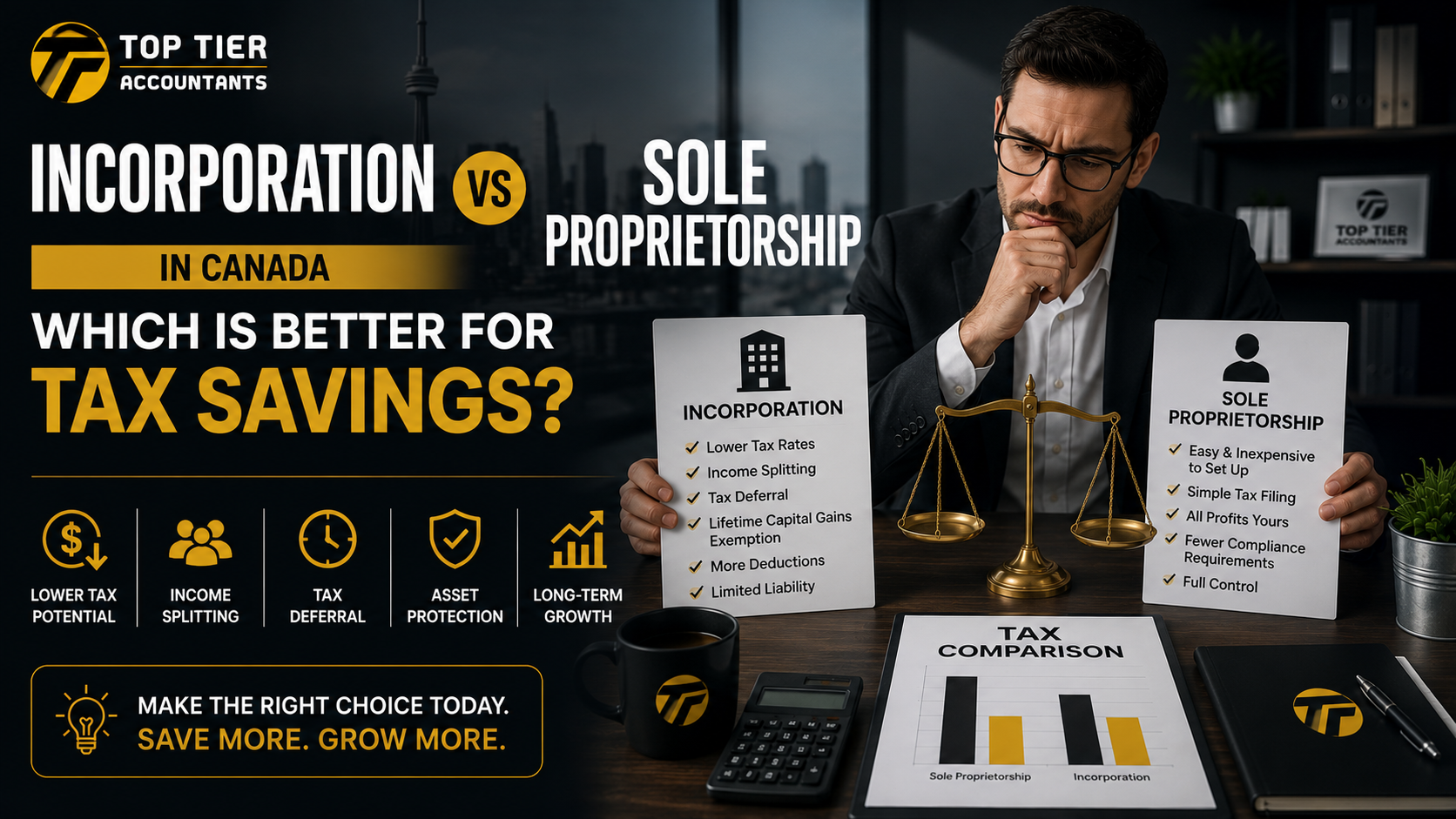
Incorporation vs Sole Proprietorship in Canada: Which Is Better for Tax Savings?
Starting a business in Canada often begins with a simple but powerful question: Should you incorporate or operate as a sole proprietor? At first glance, the decision may seem purely administrative—just paperwork and legal structure. But once taxes enter the conversation, the choice becomes far more strategic. The structure you choose can significantly influence how much tax you pay, when you pay it, and how efficiently you can grow your business.
Many entrepreneurs begin as sole proprietors because it’s simple and inexpensive. You can start working immediately, track your income and expenses, and report everything on your personal tax return. It’s quick, straightforward, and perfect for freelancers or small side businesses. But as profits increase, the tax burden can rise sharply because all income is taxed at personal rates.
Incorporation, on the other hand, creates a separate legal entity. The company pays corporate taxes, and the owner is taxed only when money is withdrawn. This structure introduces powerful tax planning strategies, including income deferral, salary-dividend planning, and income splitting.
The challenge is that incorporation is not automatically better for taxes. For some businesses it saves thousands every year. For others it simply adds administrative work and accounting costs.
Understanding the tax differences between these two structures is essential if you want to keep more of your profits while staying compliant with Canadian tax rules.
Understanding Business Structures in Canada
Before diving into tax comparisons, it’s important to understand how these two business structures actually work. Each structure changes how income is reported, how taxes are paid, and how financial responsibilities are handled.
What Is a Sole Proprietorship?
A sole proprietorship is the simplest business structure in Canada. In this model, the business and the owner are legally the same entity. There is no separation between personal finances and business finances, which means profits and losses flow directly to the owner.
All income earned by the business must be reported on the owner’s personal tax return using the T1 Income Tax Return and the T2125 Statement of Business or Professional Activities.
This structure has several advantages. It’s extremely easy to set up, requires minimal paperwork, and has very low administrative costs. Many freelancers, consultants, and small service providers start this way because it allows them to begin earning income without dealing with complex corporate filings.
But there is a trade-off. Since the business and the owner are legally the same person, all profits are taxed at personal income tax rates.
Those rates increase as income rises. In many provinces, the top combined federal and provincial personal tax rates can exceed 50%, which means a significant portion of profits goes to taxes once the business becomes highly profitable.
This tax structure works well for smaller businesses with modest income, but it becomes less attractive as profits grow.
What Is an Incorporated Business?
An incorporated business, also known as a corporation, is a completely separate legal entity from its owner. The corporation earns income, pays expenses, files its own tax return, and pays corporate taxes on its profits.
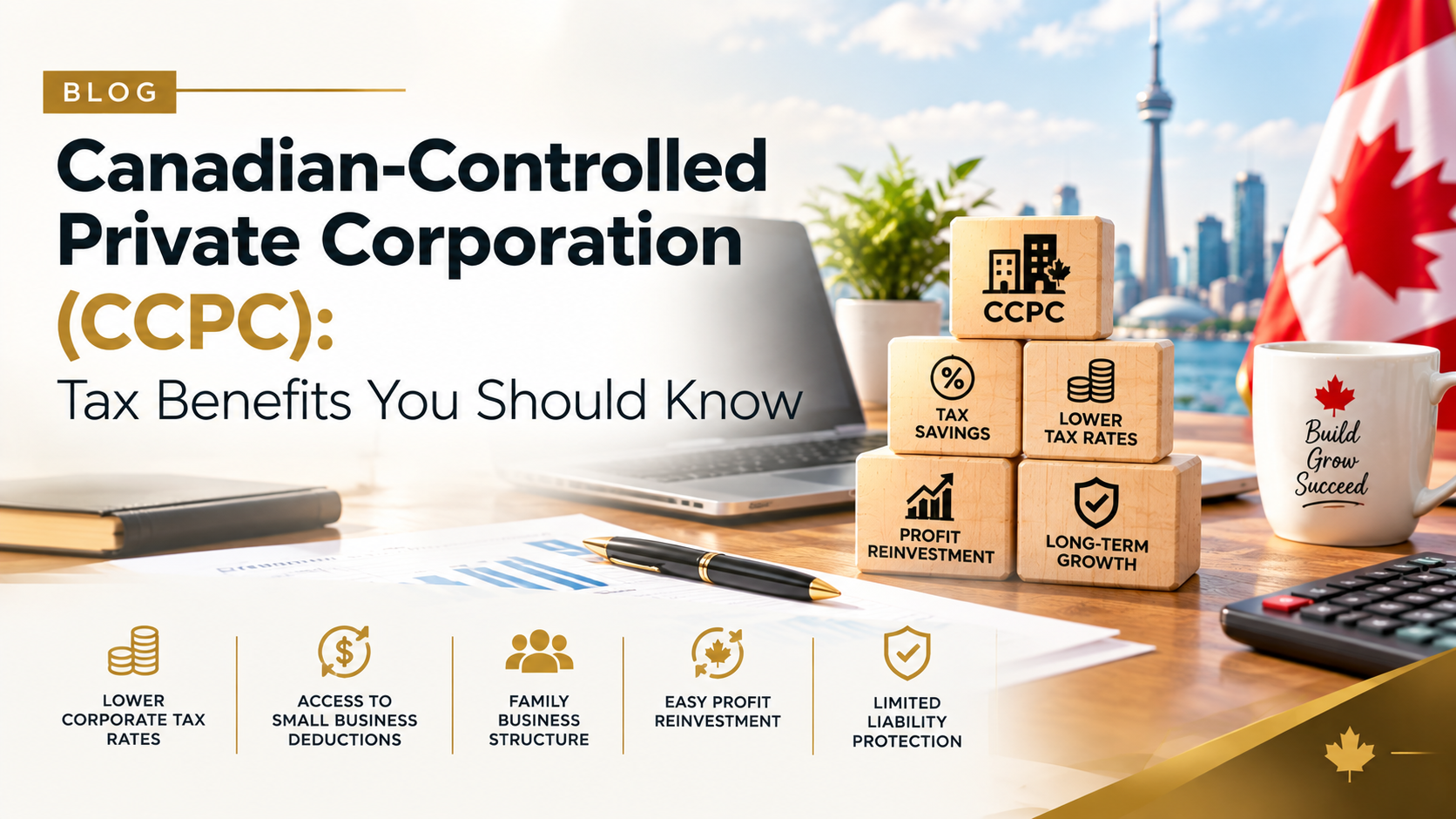
In Canada, most small incorporated businesses qualify as Canadian-Controlled Private Corporations (CCPCs). This classification provides access to the Small Business Deduction, which significantly reduces corporate tax rates.
The corporation files a T2 corporate tax return, and business profits are taxed at corporate rates first. The owner then pays personal tax only on the money they withdraw from the company through salary, dividends, or other compensation.
This separation introduces flexibility that does not exist in a sole proprietorship. Instead of paying tax on all profits immediately, business owners can decide how much income to withdraw and how much to keep inside the company.
That ability to control the timing of personal taxation is one of the biggest tax advantages of incorporation.
How Taxes Work for Sole Proprietors
Taxes for sole proprietors are straightforward, but simplicity often comes at a cost when profits increase.
Personal Income Tax Rates for Self-Employed Individuals
Sole proprietors pay taxes using Canada’s progressive personal income tax system. As your income increases, the tax rate applied to additional income also increases.
Canada’s federal personal tax brackets range from 15% to 33%, and provincial taxes add another 5% to 25% depending on the province.
When combined, the top marginal rates in some provinces exceed 50% for high-income earners.
This means a sole proprietor earning substantial profits may end up paying more than half of additional income in taxes.
The situation is similar to filling a bucket with water while someone keeps scooping water out the top. The more income you earn, the more tax gets removed. For growing businesses, this can limit how much capital remains available for expansion, hiring, or reinvestment.
Reporting Income on the T1 Return
Sole proprietors report their income annually on their personal tax return. The key form used is the T2125 Statement of Business or Professional Activities.
All business revenue and expenses are recorded here, and the resulting profit is added directly to personal income.
This structure has advantages when the business is in its early stages. If the business experiences losses, those losses can offset other personal income, such as employment income from another job.
However, once profits grow substantially, there is no way to defer taxes. Every dollar of profit must be taxed in the same year it is earned, even if the owner plans to reinvest the money back into the business.
How Corporate Taxes Work in Canada
Corporate taxation introduces more complexity but also more planning opportunities.
The Small Business Deduction Explained
One of the biggest tax advantages of incorporation in Canada is the Small Business Deduction (SBD).
This tax incentive reduces the federal corporate tax rate from 15% to 9% on the first $500,000 of active business income earned by eligible Canadian-controlled private corporations.
After provincial taxes are added, the combined corporate tax rate for small businesses usually falls between 11% and 13% depending on the province.
Here’s a simplified comparison:
| Tax Type | Typical Rate |
| Small business corporate tax | 11%–13% |
| General corporate tax | 23%–27% |
| Top personal tax rate | Up to 50%+ |
This large difference between corporate and personal tax rates creates opportunities for tax deferral and strategic income planning.
Corporate Tax Filing and Compliance
While corporate taxes offer benefits, they also require more administration.
Corporations must:
- File a T2 corporate tax return
- Maintain corporate financial statements
- Track shareholder transactions
- Follow payroll and dividend regulations
These additional requirements mean that most corporations require professional accounting support. Annual accounting and legal costs for corporations can range from $1,500 to $3,000 or more per year, depending on complexity.
This cost is an important factor when deciding whether incorporation is worthwhile.
Tax Rate Comparison Between Sole Proprietorship and Incorporation
The most common reason entrepreneurs consider incorporation is the difference in tax rates.
Personal Tax Rates vs Corporate Tax Rates
The difference between personal and corporate tax rates can be dramatic.
If a sole proprietor earns $200,000 in profit, much of that income may fall into high personal tax brackets. Depending on the province, a large portion of the income could be taxed near the top marginal rate.
An incorporated business earning the same amount might pay a combined corporate tax rate around 11%–13% on the first $500,000 of income.
However, the story doesn’t end there. When the owner withdraws money from the corporation, personal tax still applies. Canada’s tax system is designed around integration, meaning that over time the total tax paid personally and corporately is intended to be roughly similar.
The key benefit isn’t necessarily permanent tax savings—it’s tax deferral.
Tax Deferral Opportunities in Corporations
Tax deferral occurs when a business owner leaves profits inside the corporation instead of withdrawing them immediately.
Because corporate tax rates are lower, the business can retain more capital for reinvestment. That extra capital can fund marketing, equipment purchases, hiring employees, or expanding operations.
Imagine planting seeds in a garden. If you harvest every seed immediately, your garden never grows. But if you leave some seeds in the soil, they multiply. Tax deferral works the same way—retained earnings allow businesses to grow faster.
Key Tax Advantages of Incorporating a Business
Beyond tax deferral, corporations provide several additional tax planning opportunities.
Income Splitting and Salary vs Dividends
Incorporated business owners can pay themselves through:
- Salary
- Dividends
- A combination of both
This flexibility allows business owners to design compensation strategies that minimize total tax.
For example:
- Salary creates RRSP contribution room
- Dividends avoid CPP contributions
- A mix of both balances retirement savings and tax efficiency
Income splitting may also be possible by employing family members or paying dividends to shareholders under certain conditions.
Retaining Earnings Inside the Company
One of the most powerful advantages of incorporation is the ability to retain profits within the company.
When profits remain in the corporation, they are taxed only at the lower corporate rate until withdrawn.
This strategy allows businesses to accumulate capital for:
- Business expansion
- Investments
- Purchasing equipment
- Hiring employees
For growing companies, this advantage can accelerate growth dramatically.
When a Sole Proprietorship Is More Tax Efficient
Despite the benefits of incorporation, there are many situations where a sole proprietorship is actually the better tax choice.
Lower Income Businesses
If your business earns modest profits and you need to withdraw most of the money to support personal living expenses, incorporation may provide little tax advantage.
This happens because once corporate profits are withdrawn as salary or dividends, personal tax applies anyway.
If the owner takes out all profits each year, the tax result can be very similar to operating as a sole proprietor—except with additional administrative costs.
Sole proprietorships also provide flexibility for startups because business losses can offset other personal income.
For new businesses that are still testing their market, this structure often makes more financial sense.
Other Factors Beyond Taxes
Taxes are important, but they are not the only factor when choosing a business structure.
Liability Protection
Incorporation provides limited liability protection, meaning the corporation is legally separate from its owners.
If the business faces lawsuits or financial obligations, personal assets are generally protected.
Sole proprietors, however, remain personally responsible for business debts and liabilities.
Administrative Costs and Complexity
Sole proprietorships require minimal paperwork and have very low operating costs.
Corporations involve:
- Legal registration
- Corporate records
- Annual filings
- Professional accounting support
For small businesses with limited revenue, these additional costs may outweigh tax benefits.
When Should You Incorporate Your Business in Canada?
There is no universal answer, but several indicators suggest incorporation might be beneficial:
- Your business consistently earns $100,000+ in profit
- You can leave money inside the business
- You want liability protection
- You plan to scale or hire employees
- You want more tax planning flexibility
Many entrepreneurs start as sole proprietors and incorporate later when profits grow.
This staged approach allows businesses to remain simple early on while gaining tax advantages once revenue increases.
Conclusion
Choosing between incorporation and sole proprietorship in Canada is one of the most important financial decisions entrepreneurs make. Each structure has unique tax implications, administrative requirements, and growth opportunities.
Sole proprietorships offer simplicity, low startup costs, and straightforward tax filing. They work well for freelancers, small side businesses, and entrepreneurs earning modest profits.
Incorporation introduces more complexity but unlocks powerful tax planning strategies. Lower corporate tax rates, income deferral opportunities, and flexible compensation options allow business owners to manage taxes strategically and reinvest profits into growth.
The best choice depends on your income level, financial goals, and business plans. Many successful entrepreneurs begin as sole proprietors and incorporate once profits increase and tax planning becomes more valuable.
Understanding these differences helps business owners make informed decisions and build a structure that supports long-term success.
FAQs
1. Is incorporation always better for taxes in Canada?
No. Incorporation is usually beneficial only when profits are high enough to leave some earnings inside the corporation.
2. What is the small business tax rate in Canada?
The federal small business tax rate is 9% on the first $500,000 of active business income, with combined provincial rates typically bringing the total to 11%–13%.
3. Do sole proprietors pay more tax than corporations?
Often yes at higher income levels because sole proprietors pay personal income tax rates that can exceed 50% in some provinces.
4. Can a sole proprietor incorporate later?
Yes. Many entrepreneurs start as sole proprietors and incorporate once their business becomes profitable.
5. What is the biggest advantage of incorporating a business?
The biggest advantage is tax deferral, which allows profits to remain inside the corporation and grow before personal taxes are applied.
Post a comment
Related Posts
August 31, 2026
5 Bookkeeping Reports Every Canadian Business Owner Should Review Monthly
Why Monthly Financial Reporting Matters Running a Canadian business without regularly reviewing your bookkeeping reports…

August 8, 2026
How to Set Up a CRA Payroll Account for Your Business
What Is a CRA Payroll Account? If your Canadian business is hiring employees, one of…

August 8, 2026
How to Reduce Your Corporate Tax Legally in Canada (2026 Guide)
Every business owner wants to keep more of their hard-earned profits, but reducing your tax…

August 8, 2026
How to File Complex Tax Returns for Canadian Businesses
Filing a corporate tax return in Canada can become complicated as a business grows. A…