

Why Monthly Financial Reporting Matters
Running a Canadian business without regularly reviewing your bookkeeping reports is a little like driving a car without checking the dashboard. You may keep moving, but you won’t necessarily know whether you’re heading toward healthy growth or a financial problem. Monthly bookkeeping reports give business owners a current view of revenue, expenses, cash, outstanding invoices, debts, and overall financial position. The Canada Revenue Agency recognizes financial statements, transaction journals, bank reconciliations, accounts receivable and payable lists, payroll journals, and inventory records as examples of business financial records.
Monthly reporting also makes tax preparation easier because your records remain organized throughout the year. Canadian businesses are required to keep records supporting their income and expense claims, and the CRA expects those records to contain enough information to determine tax obligations and entitlements. Instead of waiting until tax season to discover missing transactions or unusual expenses, reviewing reports every month lets you identify issues while the information is still fresh. For a small business owner, that can mean better cash management, better budgeting, and fewer unpleasant surprises.
1. Profit and Loss Statement
The Profit and Loss Statement, often called the P&L or income statement, should be one of the first reports a Canadian business owner reviews every month. It shows the relationship between your business revenue and expenses over a specific period, helping you understand whether the company generated a profit or loss. While the report may look simple, it can reveal important trends that are easy to miss when you only look at your bank balance.
For example, imagine your business generated $80,000 in sales this month compared with $65,000 last month. That sounds positive, right? But if operating expenses increased from $40,000 to $60,000, your additional sales may not have produced the expected improvement in profitability. A monthly P&L lets you examine revenue, cost of goods sold, operating expenses, and net income together rather than viewing each number in isolation.
What Your Profit and Loss Report Reveals
Pay attention to changes in gross profit margins, advertising expenses, payroll, rent, professional fees, software subscriptions, and other recurring costs. Comparing the current month with previous months or the same period in the previous year can highlight unusual movements. CRA guidance also emphasizes maintaining records of business income and expenses and supporting income entries with original documents such as invoices, receipts, deposit slips, and contracts.
| P&L Area | What to Review |
| Revenue | Sales growth and unusual changes |
| Cost of Sales | Gross margin and purchasing costs |
| Operating Expenses | Rising or unexpected expenses |
| Net Profit | Overall business profitability |
| Monthly Comparison | Trends versus previous periods |
2. Balance Sheet
The Balance Sheet provides a different perspective. While the P&L focuses on performance over a period, the balance sheet shows your financial position at a particular date. It generally organizes the business around assets, liabilities, and equity.
Assets can include cash, accounts receivable, inventory, equipment, and other resources owned by the business. Liabilities can include supplier balances, loans, credit cards, taxes payable, and other obligations. Equity represents the owner’s or shareholders’ interest after liabilities are considered.
Understanding Assets, Liabilities and Equity
Why should a small business owner care about this report? Because a company can show a profit while still experiencing financial pressure. Perhaps customers owe the business a large amount of money, inventory has increased significantly, or loan obligations are growing. The balance sheet can reveal these conditions even when the P&L looks healthy.
The CRA’s financial reporting guidance includes balance-sheet categories such as cash and deposits and accounts receivable, showing why these balances form an important part of organized business records.
Review whether cash balances make sense, whether customer receivables are growing too quickly, and whether liabilities are increasing faster than assets. If something looks unusual, investigate it rather than simply accepting the number.
3. Cash Flow Report
Cash flow is the heartbeat of a small business. Your P&L might tell you that you’re profitable, but your cash-flow report tells you whether money is actually moving through the business in a way that allows you to pay employees, suppliers, taxes, loans, and other obligations.
Consider a company that invoices customers for $100,000 but has collected only $45,000. On paper, revenue may look excellent, but the business could still struggle to pay its bills. This is why reviewing cash flow every month is essential, particularly for businesses that sell on credit or have long payment cycles.
Why Profit Does Not Always Mean Cash
A monthly cash-flow review should consider money coming into the business, operating payments, financing activities, loan repayments, major purchases, and other significant movements. Compare actual cash flow with your expectations and identify upcoming periods where cash could become tight.
The CRA also identifies bank statements, deposit records, accounts receivable and payable records, and related financial documents as important business records that provide information about cash flow and balances.
A good cash-flow report can help you decide whether to accelerate customer collections, postpone a non-essential purchase, negotiate supplier terms, or reserve funds for upcoming obligations.
4. Accounts Receivable Aging Report
The Accounts Receivable Aging Report shows how much money customers owe your business and how long those invoices have remained unpaid. This report becomes particularly important as your sales volume increases because higher sales don’t necessarily mean stronger cash flow if customers are slow to pay.
A useful aging report may separate invoices into categories such as current, 30 days overdue, 60 days overdue, and 90+ days overdue. Reviewing it monthly allows you to identify customers who consistently pay late and invoices that need immediate follow-up.
Managing Outstanding Customer Invoices
Don’t treat accounts receivable as just an accounting number. It represents money your business expects to receive. If $50,000 is sitting in overdue invoices, that money cannot be used to pay suppliers, invest in inventory, hire staff, or support expansion until customers actually pay.
The CRA recognizes accounts receivable and related ledgers as business financial records, and these records can provide information about cash flow and business assets.
Create a simple monthly habit: identify overdue invoices, confirm that customer statements are accurate, follow up on significant balances, and investigate old receivables that may require special attention.
5. Accounts Payable Report
The Accounts Payable Report shows what your business owes to suppliers and other creditors. Reviewing it every month helps prevent missed payments, duplicate payments, late fees, and unnecessary cash-flow pressure.
A growing payable balance isn’t automatically a problem. Sometimes it simply reflects normal payment terms. The concern arises when overdue obligations continue accumulating or when upcoming payments exceed the cash available to meet them.
Controlling Supplier Payments
Review supplier balances by due date and prioritize payments according to agreed terms and available cash. Make sure invoices are legitimate, properly recorded, and not duplicated. You should also check whether expenses have been assigned to the correct accounting categories.
Accounts payable records are part of the broader financial records the CRA may expect businesses to maintain. A clean payable system therefore helps with both day-to-day financial management and year-end accounting.
How These Reports Work Together
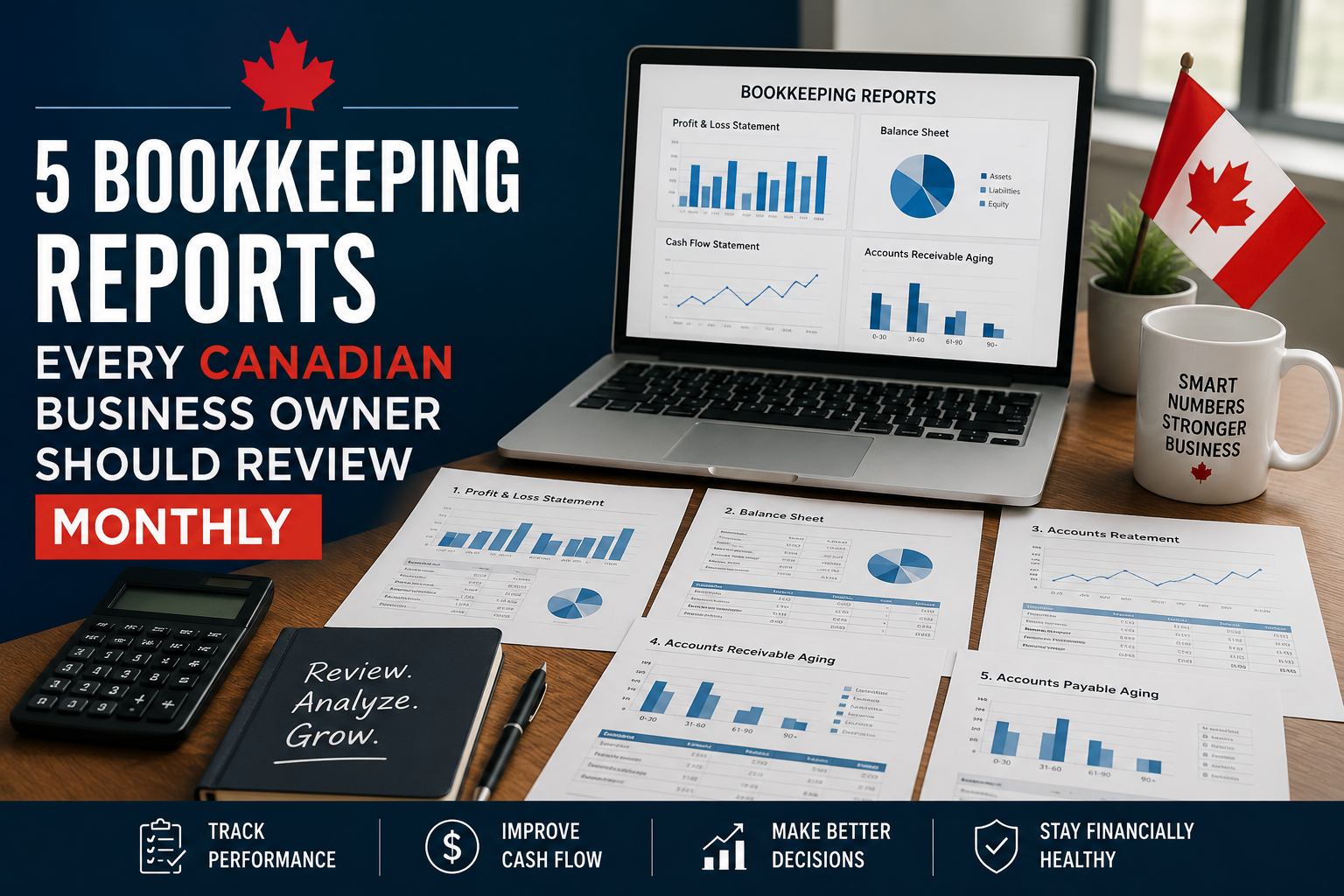
These five reports should not be treated as separate pieces of information. They work together like different instruments on the same dashboard. The P&L tells you how profitable the business is, the Balance Sheet shows what the business owns and owes, the Cash Flow Report shows movement of money, the Accounts Receivable Report shows expected customer collections, and the Accounts Payable Report shows upcoming obligations.
| Report | Main Question It Answers |
| Profit & Loss | Are we making money? |
| Balance Sheet | What do we own and owe? |
| Cash Flow | Where is our cash going? |
| Accounts Receivable | Who owes us money? |
| Accounts Payable | Who do we owe money to? |
When you review all five together, you get a much more complete picture of business health. You may discover, for example, that profits are increasing but cash is declining because receivables are taking longer to collect. Or perhaps sales are stable but expenses are rising faster than revenue. These insights are difficult to see if you look at only one report.
Monthly Bookkeeping Review Checklist
A practical monthly review can be completed using a consistent routine. First, reconcile business bank and credit-card accounts and make sure the accounting system agrees with external statements. Then review the P&L, balance sheet, cash flow, receivables, and payables for unusual changes.
Also check supporting documents. CRA guidance requires businesses to keep adequate records supporting transactions and generally requires relevant records to be retained for six years, subject to applicable exceptions.
Your monthly process should include:
- Reconcile bank and credit-card accounts.
- Review revenue and expenses.
- Check accounts receivable and overdue invoices.
- Review supplier balances and upcoming payments.
- Verify GST/HST records where applicable.
- Check payroll records where applicable.
- Review financial statements and unusual movements.
- Organize invoices, receipts, and supporting documents.
When to Work With a Professional Accountant
You don’t have to manage every bookkeeping task alone. As transactions become more complicated, professional accounting support can help keep records accurate and financial reporting consistent. This can be especially useful for businesses with employees, inventory, multiple locations, significant receivables, GST/HST obligations, or financing arrangements.
A professional accountant can also help you interpret reports rather than simply prepare them. The real value of monthly reporting comes from understanding why the numbers changed and what action should follow. Accurate records give you the information; professional advice can help turn that information into better business decisions.
Conclusion
Reviewing bookkeeping reports monthly gives Canadian business owners a clearer understanding of where their company stands financially. The Profit and Loss Statement, Balance Sheet, Cash Flow Report, Accounts Receivable Aging Report, and Accounts Payable Report each answer a different financial question, but together they provide a complete picture of business performance and financial health.
Regular reviews also help identify errors, manage cash flow, monitor customer collections, control supplier obligations, and maintain organized records for tax and compliance purposes. With accurate bookkeeping and timely reporting, business owners can spend less time guessing and more time making informed decisions.
Top Tiers Accountant can help Canadian businesses maintain organized bookkeeping records and understand the financial reports that matter most for sustainable growth.
FAQs
1. How often should a small business review bookkeeping reports?
For most small businesses, reviewing key reports monthly is a practical approach. Businesses with high transaction volumes may benefit from weekly reviews of cash, receivables, and other critical information.
2. Which bookkeeping report is most important?
There isn’t one report that answers every question. The P&L, Balance Sheet, Cash Flow, Accounts Receivable, and Accounts Payable reports provide different information and are most useful when reviewed together.
3. Can bookkeeping reports help with tax preparation?
Yes. Accurate financial records help organize business income and expenses and provide supporting information needed for tax reporting. CRA requires businesses to maintain records supporting their income and expense claims.
4. What happens if accounts receivable keeps increasing?
Growing receivables can mean sales are increasing, but it can also indicate customers are paying more slowly. Review the aging report, follow up on overdue invoices, and investigate significant old balances.
5. How long should Canadian businesses keep bookkeeping records?
Generally, business records and supporting documents must be kept for six years from the end of the relevant tax year, although specific circumstances can result in different requirements.
Post a comment
Related Posts

August 8, 2026
How to Set Up a CRA Payroll Account for Your Business
What Is a CRA Payroll Account? If your Canadian business is hiring employees, one of…

August 8, 2026
How to Reduce Your Corporate Tax Legally in Canada (2026 Guide)
Every business owner wants to keep more of their hard-earned profits, but reducing your tax…

August 8, 2026
How to File Complex Tax Returns for Canadian Businesses
Filing a corporate tax return in Canada can become complicated as a business grows. A…
August 8, 2026
Corporate Tax Returns in Canada: A Complete Guide for Small Businesses (2026)
Corporate Tax Returns in Canada: A Complete Guide for Small Businesses (2026) Running a corporation…