


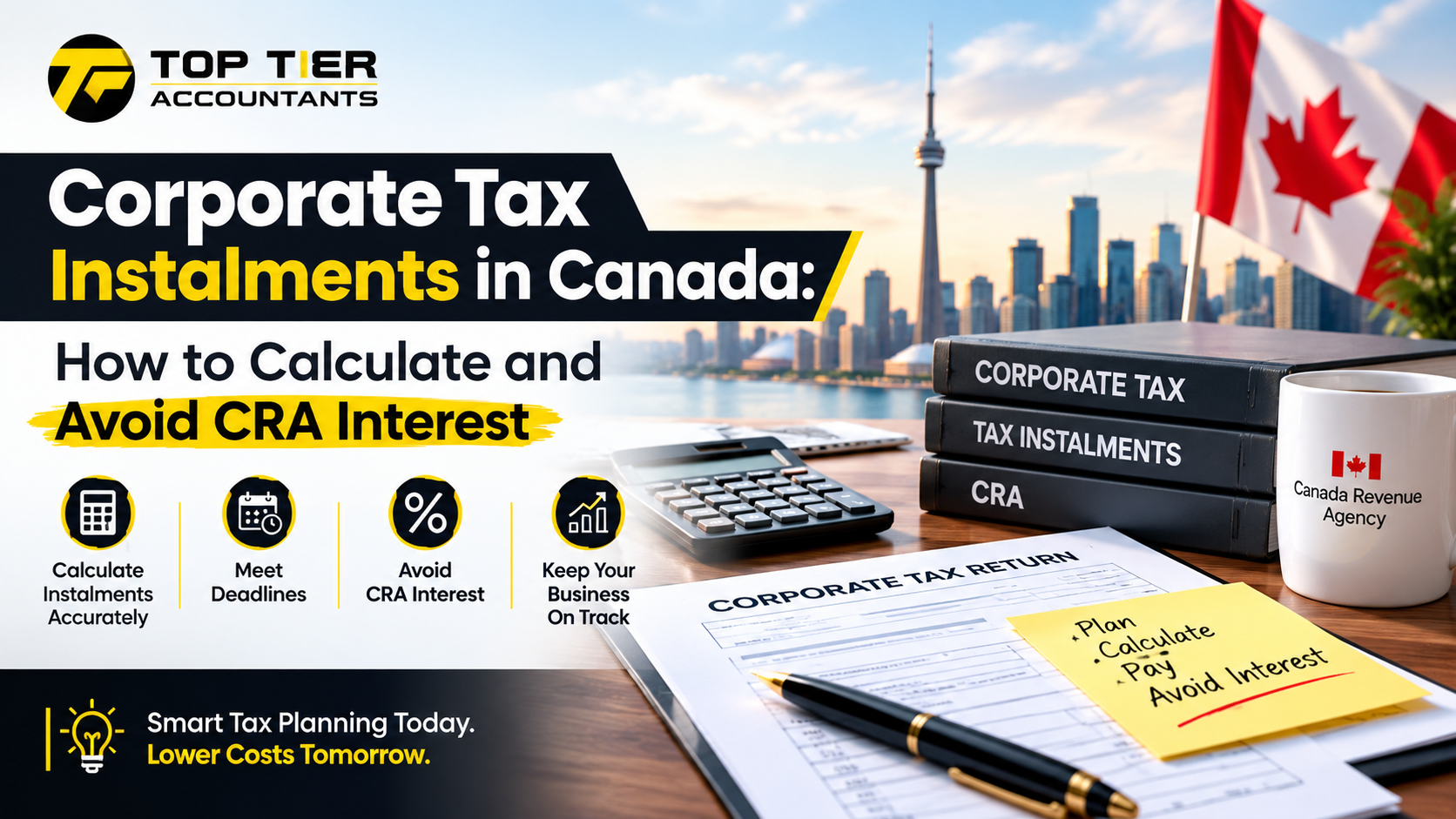
For many Canadian business owners, corporate tax instalments can feel confusing. You make payments throughout the year, but your corporation’s final tax liability is not known until the tax return is prepared. So how much should you pay? Should you base your instalments on last year’s tax, this year’s estimated tax, or an earlier year? And what happens if you underestimate?
These questions matter because corporate tax instalments are not simply optional deposits toward a future tax bill. For corporations that are required to make instalments, paying too little or paying late can result in CRA instalment interest and, in certain circumstances, an additional penalty.
The good news is that the system provides several calculation methods. The CRA currently recognizes three main options for determining corporate instalments: the current-year estimate, previous-year tax, or a combination of the previous two years’ tax.
For Canadian small businesses, the key is to understand the rules before the payment dates arrive. Top Tier Accountants can help business owners review projected tax, cash flow, instalments, and year-end obligations so that tax payments become part of a planned financial strategy rather than an unexpected expense.
What Are Corporate Tax Instalments?
Corporate tax instalments are partial payments of a corporation’s expected income tax liability made during the tax year. Instead of waiting until the corporation files its T2 return and paying the entire tax amount afterward, qualifying corporations generally pay their tax throughout the year.
The CRA explains that corporations are generally required to make tax instalments monthly, although certain eligible Canadian-controlled private corporations (CCPCs) can qualify for quarterly payments. The system is designed to collect corporate income tax progressively rather than leaving the government to collect the entire amount after the fiscal year has ended.
Think of instalments like filling a financial bucket throughout the year. Each payment adds to the amount you will eventually need to pay. If you contribute enough along the way, your final tax balance may be manageable. If you consistently underestimate the required amount, however, you could face a large balance when the return is filed and potentially instalment interest.
Why the CRA Requires Instalment Payments
The concept is straightforward: if your corporation is earning taxable income during the year, the CRA generally expects tax to be paid progressively rather than postponed until the end.
This means corporate tax planning should not begin when your accountant sends you the T2 return. By that point, the tax year has already ended. A stronger approach is to monitor your expected taxable income throughout the year and compare that estimate with your instalments.
That is especially important for growing businesses. A corporation that earned $100,000 of taxable income last year could potentially have a very different tax liability if revenue has increased significantly this year. Using old numbers without reviewing current performance may create a cash-flow surprise.
Who Has to Pay Corporate Tax Instalments?
Most established corporations with tax payable are required to make instalment payments. However, the CRA provides exceptions, including situations involving a corporation’s first tax year and certain corporations with relatively small amounts of tax payable.
The CRA states that a corporation generally does not have to make instalments for most corporate taxes during its first tax year. The corporation instead pays any tax owing by its balance-due date. Instalment requirements generally begin with the second tax year.
First-Year Corporations and the $3,000 Threshold
There is also an important threshold. For several categories of corporate tax, a corporation generally does not have to make instalments if its tax payable is $3,000 or less for either the current or previous tax year, subject to the CRA’s specific rules and exceptions.
That does not mean the tax disappears. If your corporation owes tax when it files its return, the balance still needs to be paid by the applicable balance-due date.
This distinction is important. No instalment requirement does not mean no corporate tax liability.
When Are Corporate Tax Instalments Due?
The timing depends on whether the corporation is required to pay monthly or qualifies for quarterly instalments. Most corporations make monthly payments, while certain eligible CCPCs may pay quarterly.
The payment schedule should be based on the corporation’s fiscal year, not simply the calendar year. This is one reason business owners should confirm their fiscal year-end and payment schedule rather than assuming every company follows the same dates.
Monthly Instalment Schedule
For a corporation making monthly instalments, the annual instalment base is generally divided into 12 payments.
For example, if the applicable instalment calculation produces an annual base of $60,000, a straightforward monthly calculation would be $5,000 per month.
The actual calculation can be more nuanced depending on which CRA option is used and the corporation’s prior-year tax history. The CRA’s current worksheets provide specific formulas for 2026 instalments.
Quarterly Instalments for Eligible CCPCs
Certain eligible Canadian-controlled private corporations can make quarterly instalments rather than monthly payments.
If the annual instalment base were $60,000, a basic quarterly calculation would produce four payments of $15,000 under the appropriate calculation method.
Quarterly payments can make cash-flow management easier for some smaller corporations, but eligibility should be confirmed rather than assumed.
How to Calculate Corporate Tax Instalments
The CRA provides three calculation options. Understanding these options is one of the most important parts of corporate tax planning.
Option 1 — Current-Year Tax Estimate
Under Option 1, the corporation bases instalments on its estimated tax payable for the current year.
For monthly payments:
Estimated annual tax ÷ 12 = monthly instalment
For quarterly payments:
Estimated annual tax ÷ 4 = quarterly instalment
This method can work well when you have reliable financial forecasts and expect your current-year tax liability to be significantly lower than prior years.
But there is a risk. If your estimate is too low, the corporation may not have paid enough instalments. The CRA states that interest can apply when Option 1 is used and the estimate is lower than the actual tax payable and the amount determined under the other applicable options.
Option 2 — Previous-Year Tax
Option 2 bases instalments on the corporation’s previous-year tax payable.
For a monthly payer:
Previous-year tax ÷ 12 = monthly instalment
For an eligible quarterly payer:
Previous-year tax ÷ 4 = quarterly instalment
This approach is often attractive because it is easier to calculate. You already have the previous year’s T2 return, so you are working from an actual tax figure rather than forecasting the current year.
The CRA notes that if instalments are based on the previous year’s tax or the combination method, the corporation does not generally need to recalculate those payments simply because it expects the current year’s tax to be higher.
Option 3 — Previous Two Years
Option 3 uses information from the previous two tax years.
For monthly instalments, the first two payments are based on the tax from the year before the previous year. The remaining payments use the previous year’s tax after accounting for those initial instalments.
This option can sometimes provide lower payments earlier in the year, which can help with cash flow.
The CRA’s current guidance indicates that Option 3’s total instalment base is generally the same as Option 2, but its payment timing can result in lower initial payments.
Example of a Corporate Tax Instalment Calculation
Imagine ABC Consulting Inc., an eligible Canadian small business, has the following tax history:
| Tax Year | Tax Payable |
| 2024 | $24,000 |
| 2025 | $36,000 |
| Estimated 2026 | $30,000 |
Under Option 1, the company could calculate:
$30,000 ÷ 12 = $2,500 per month
Under Option 2:
$36,000 ÷ 12 = $3,000 per month
The company may then compare the available options and determine which produces the appropriate instalment requirement under the CRA rules.
Choosing the Most Practical Option
The lowest monthly payment is not necessarily the best financial decision.
Suppose your business is growing rapidly and you choose an aggressive estimate that produces low instalments. You may keep more cash in the business during the year, but if the estimate turns out to be too low, you could face interest.
On the other hand, paying more than necessary may reduce your available operating cash.
The goal is to balance tax compliance, CRA interest exposure, and business cash flow. That is where regular forecasting becomes valuable.
How CRA Instalment Interest Works
CRA interest can arise when a corporation does not make the required instalments on time or does not pay enough under the applicable rules.
The exact calculation can become complicated because instalment interest depends on factors such as the required amount, payment timing, the calculation method used, and the corporation’s actual tax liability.
The CRA specifically warns that interest may apply when a corporation uses the current-year estimate and that estimate is too low compared with the actual tax payable and the applicable prior-year calculation.
Common Reasons Businesses Pay Interest
Several practical problems can lead to instalment interest:
- Underestimating current-year taxable income
- Missing an instalment deadline
- Using outdated financial information
- Assuming last year’s instalment amount will always be sufficient
- Failing to adjust for major business growth
- Confusing the corporation’s fiscal year with the calendar year
- Not monitoring instalments after a significant change in profitability
A corporation can be profitable and still experience a tax-payment problem. Profitability and cash flow are not the same thing.
Strategies to Avoid CRA Instalment Interest
Review Instalments During the Year
Do not calculate your instalments once and forget about them.
A quarterly or monthly financial review can compare:
Actual revenue → Actual expenses → Estimated taxable income → Estimated tax → Instalments paid
If your business is substantially more profitable than expected, you have an opportunity to reassess your tax position before the year ends.
The CRA also explains that corporations can change instalment amounts during the year. If a business realizes its current-year income will be higher than expected, it can increase future payments or pay early to reduce potential interest exposure.
Keep Cash Reserved for Corporate Tax
One of the simplest strategies is to treat corporate tax as a planned business obligation, not as leftover money.
If your business collects significant revenue during strong months, consider forecasting the tax associated with that profitability. Keeping an appropriate reserve can prevent the common situation where a business looks profitable on paper but does not have enough cash available when the tax payment is due.
This is particularly important for seasonal businesses, contractors, restaurants, professional corporations, and companies experiencing rapid growth.
What Happens If Your Business Income Changes?
Business income rarely moves in a straight line.
A contractor may land a major project. A restaurant may experience an unusually strong summer. A professional corporation may receive a large contract. A consulting company may lose a major client.
When profitability changes materially, tax instalments should be reviewed.
If current-year tax is expected to be lower, you may have options to adjust payments. If current-year tax is expected to be higher, increasing payments can help reduce the amount left for the final tax balance and may reduce potential instalment interest where applicable. The CRA specifically notes that businesses may increase instalments or pay early in situations where interest could otherwise apply.
Year-End Corporate Tax Instalment Checklist
Before the corporation’s fiscal year closes, review:
- Current-year revenue
- Current-year expenses
- Projected taxable income
- Tax instalments already paid
- Remaining instalments
- Previous-year tax payable
- Prior two-year tax history
- GST/HST position
- Payroll obligations
- Capital purchases
- Owner compensation
- Corporate cash reserves
- Potential year-end tax balance
A simple review can expose a problem while there is still time to respond.
How Top Tier Accountants Can Help
Corporate tax instalments are only one part of a larger tax-planning picture.
At Top Tier Accountants, Canadian small businesses can receive support with corporate tax planning, bookkeeping, financial statements, tax preparation, GST/HST, payroll, CRA accounts, and business advisory services.
The value of professional accounting is not simply calculating tax after the year ends. The bigger opportunity is using financial information throughout the year to make better decisions.
A business owner should know more than how much tax was owed last year. You should understand what your business is likely to owe this year, how much has already been paid, what remains, and how those payments affect cash flow.
That is proactive accounting.
Conclusion
Corporate tax instalments are easier to manage when they are treated as part of your business’s regular financial planning rather than an annual surprise.
The CRA provides three primary calculation approaches: current-year estimated tax, previous-year tax, and the previous-two-year method. Corporations generally make monthly payments, while eligible CCPCs may qualify for quarterly instalments.
The most effective way to reduce the risk of CRA instalment interest is to maintain accurate books, monitor profitability, review instalments throughout the year, and avoid relying blindly on outdated estimates.
Top Tier Accountants can help Canadian businesses review their corporate tax position, plan instalments, manage bookkeeping, and prepare for year-end with greater confidence.
FAQs
1. Does every Canadian corporation have to make monthly tax instalments?
Not every corporation. Corporations are generally required to make instalments, but exceptions apply, including certain first-year corporations and corporations whose applicable tax payable is $3,000 or less. Eligible CCPCs may also qualify for quarterly payments.
2. What are the three CRA corporate instalment options?
The three main options are based on estimated current-year tax, previous-year tax, or a combination of the previous two years’ tax.
3. Can I reduce my corporate instalments if business income falls?
Potentially, yes. If current-year tax is expected to be lower, instalment amounts may be adjusted. However, the calculation should be based on a reasonable estimate and the CRA’s applicable rules.
4. What happens if I underestimate my corporate tax instalments?
Depending on the calculation method and circumstances, the CRA may charge instalment interest. Using the current-year estimate is particularly important to monitor because an underestimated amount can result in interest.
5. How can Top Tier Accountants help with corporate tax instalments?
Top Tier Accountants can help review your bookkeeping and financial statements, estimate corporate tax, analyze instalment options, monitor cash flow, and prepare your business for tax filing and year-end obligations.
Post a comment
Related Posts
September 19, 2026
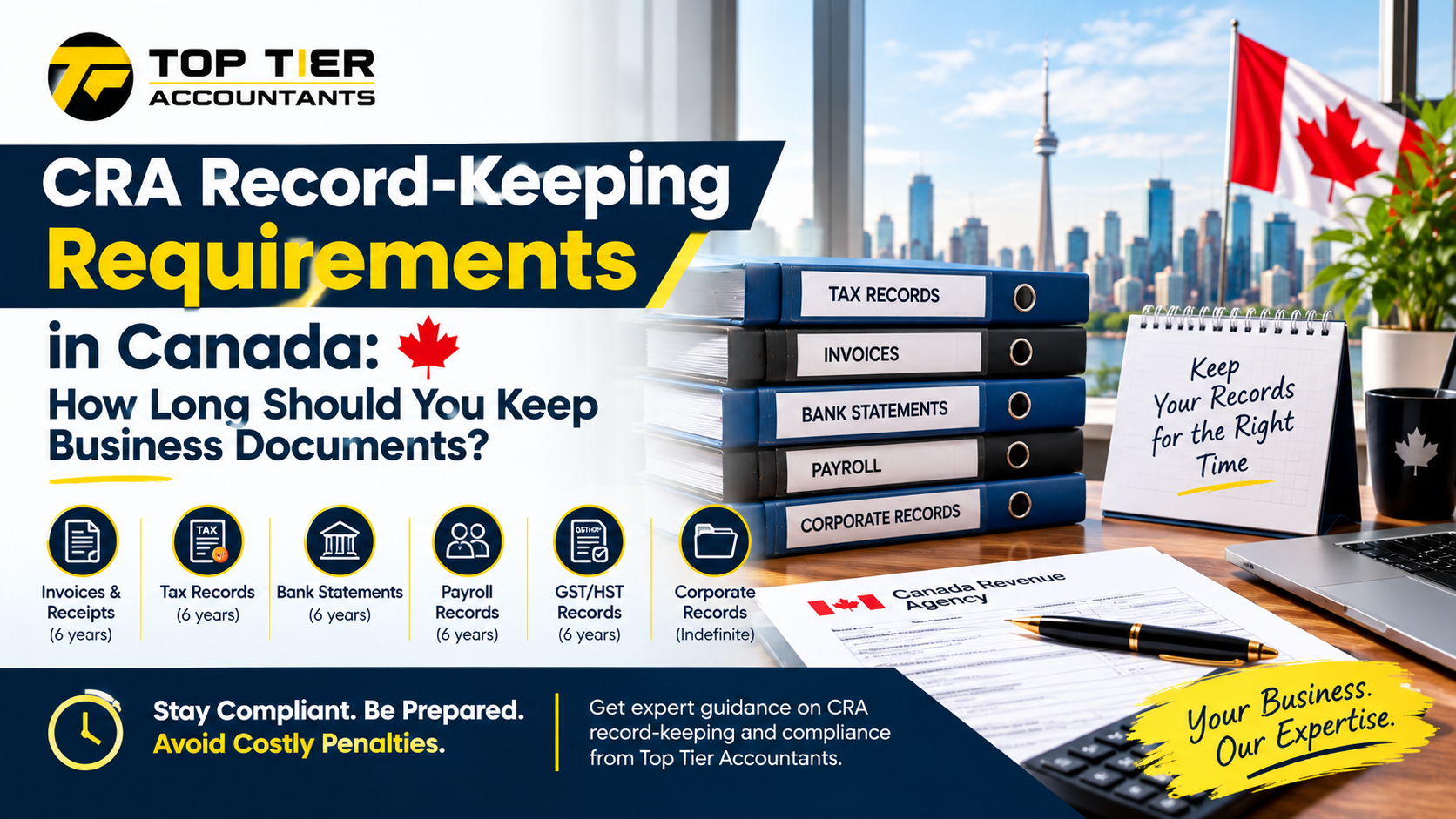
CRA Record-Keeping Requirements in Canada: How Long Should You Keep Business Documents?
Why CRA Record Keeping Matters Good record keeping is one of the most important responsibilities…
September 19, 2026
Corporate Tax Planning Mistakes That Could Cost Canadian Business Owners Thousands
Canadian business owners often focus on increasing revenue, controlling expenses, and finding new customers. Tax…
September 19, 2026
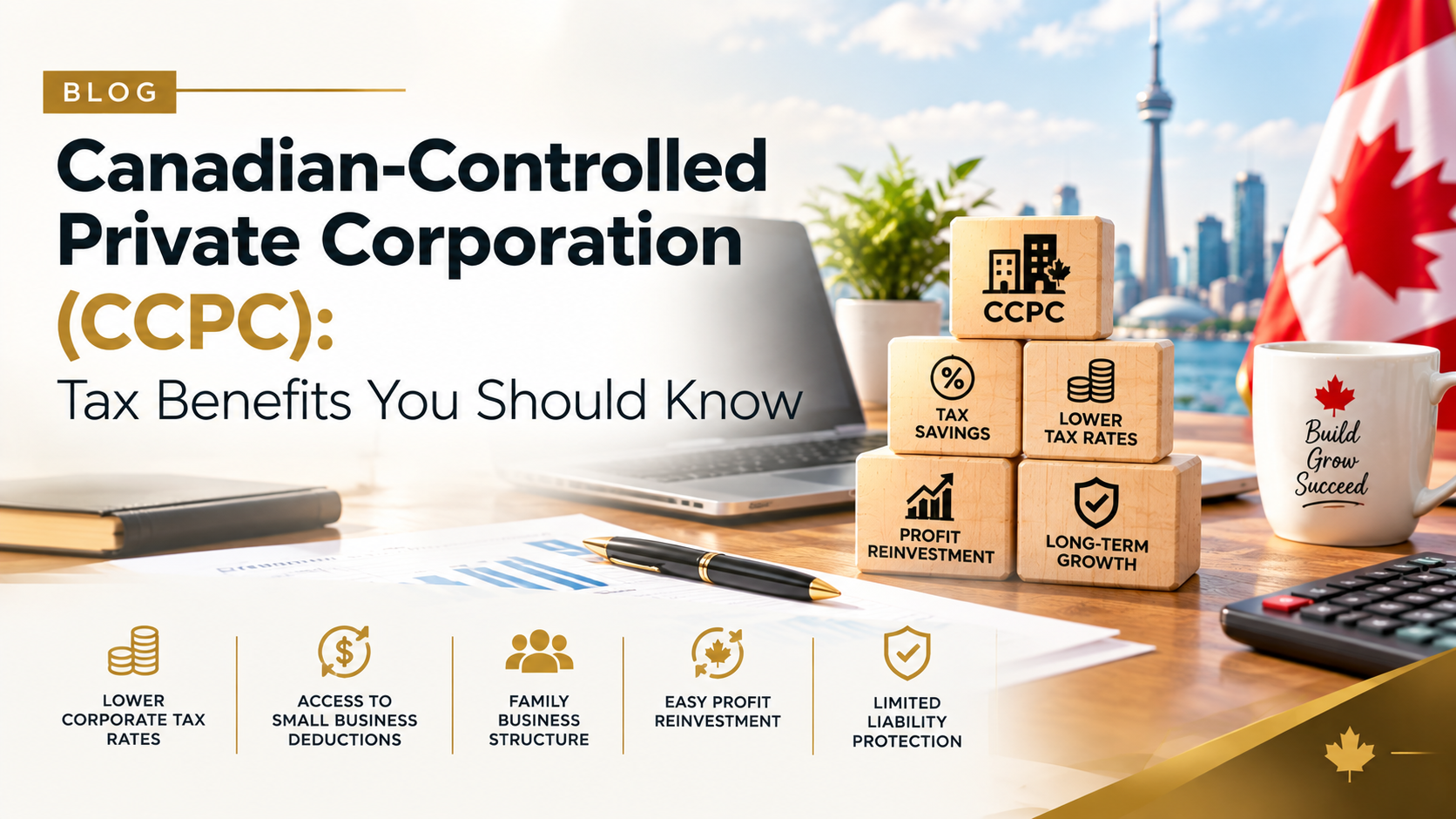
Canadian-Controlled Private Corporation (CCPC): Tax Benefits You Should Know
A Canadian-Controlled Private Corporation (CCPC) can be one of the most valuable structures available to…
September 19, 2026
Business Expenses vs Personal Expenses in Canada: Where Should You Draw the Line?
Running a small business often means your personal and business lives overlap. You might use…