


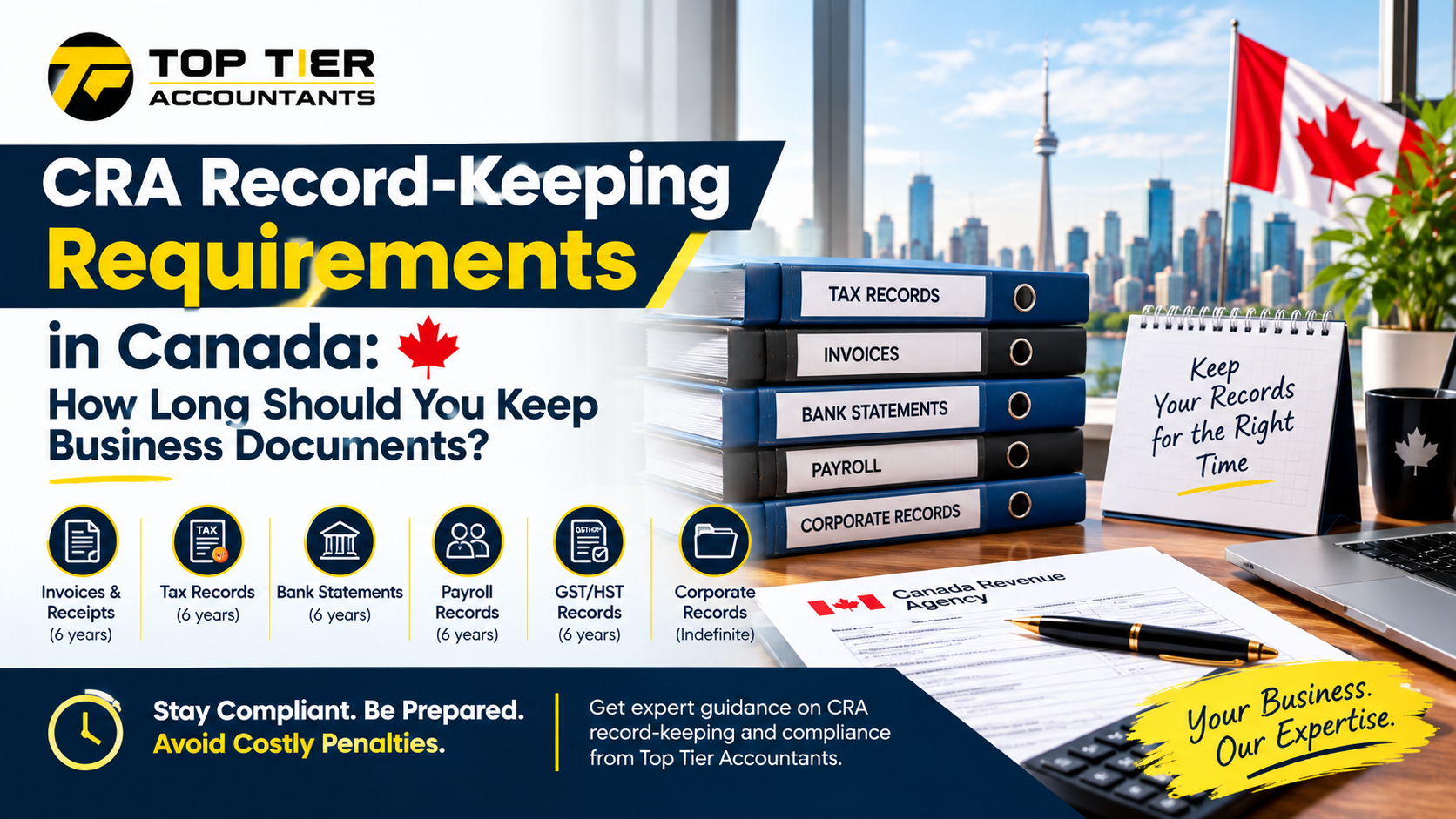
Why CRA Record Keeping Matters
Good record keeping is one of the most important responsibilities of running a business in Canada. Your bookkeeping records provide the evidence behind the income, expenses, GST/HST claims, payroll amounts, and other information reported to the Canada Revenue Agency (CRA). CRA guidance states that businesses must maintain records and supporting documents with enough detail to determine their tax obligations and entitlements.
Think of your records as the financial history of your business. If your company reports $500,000 in sales, your invoices, receipts, bank deposits, payment records, and accounting entries should allow that amount to be traced and verified. The same principle applies to expenses: if you claim a business expense, you should have documentation showing what you purchased, how much it cost, and how it relates to your business activities.
Organized records also make tax preparation considerably easier. Instead of searching through emails, bank accounts, paper receipts, and old files at tax time, you can give your accountant a structured set of records and supporting documents. This can reduce bookkeeping problems, make financial reporting more reliable, and help you respond efficiently if CRA requests documentation.
What Does CRA Consider a Business Record?
A business record is much broader than a traditional accounting ledger. CRA explains that records can include ledgers, journals, financial statements, tax returns, correspondence, charts, tables, invoices, receipts, statements, contracts, vouchers, and other documents containing financial information.
Modern businesses also create records electronically. Accounting software, point-of-sale systems, e-commerce platforms, online purchasing systems, payroll software, payment processors, and tax-preparation systems can all contain information relevant to your business records. CRA specifically requires businesses using computerized systems to retain sufficient information to allow income and tax-related amounts to be determined and verified.
This means a business should not assume that only documents submitted with a tax return need to be preserved. Supporting documentation that explains or proves the numbers in your return can be equally important.
The General Six-Year Rule
The basic CRA rule is straightforward: most required business records and supporting documents must generally be kept for six years from the end of the last tax year to which they relate. CRA’s current guidance confirms this general six-year retention period for business records.
For a corporation, the relevant tax year is generally its fiscal period. For an individual, including many sole proprietors, the tax year is generally the calendar year. The retention period is therefore based on the tax year to which the record relates rather than simply counting six years from the date printed on an invoice.
When Does the Six-Year Period Start?
This is an important distinction for business owners. The six-year period is generally calculated from the end of the last tax year to which the record relates, not necessarily from the date the transaction occurred.
For example, imagine a business purchases a major piece of equipment in 2024 and continues to claim tax-related amounts associated with that asset in later years. The supporting documentation may need to be retained beyond six years from the original purchase date because the record can continue to affect later tax calculations.
That is why simply deleting documents when an invoice becomes six years old can be risky.
Business Documents You Should Keep
A strong record-keeping system should cover the complete financial activity of your business. CRA’s guidance indicates that businesses need to retain records supporting their income and expense claims, along with relevant financial information.
Income and Sales Records
Keep documentation supporting all business income, including:
- Sales invoices
- Customer receipts
- Deposit records
- Point-of-sale reports
- E-commerce transaction records
- Payment processor statements
- Contracts and agreements
- Sales summaries
- Bank statements
- Records of cash transactions
Your records should make it possible to connect sales with the corresponding accounting entries and, where applicable, deposits.
For businesses operating online, this becomes especially important. An e-commerce transaction may involve an online order, customer invoice, payment confirmation, platform fee, inventory movement, and bank deposit. Keeping the complete transaction trail makes the accounting records much easier to understand and verify.
Expense and Purchase Records
Business owners should also retain documents supporting expenses and purchases. These can include supplier invoices, receipts, contracts, utility bills, rent records, advertising invoices, professional-fee invoices, travel documents, insurance records, and other supporting documentation.
CRA guidance emphasizes that records must contain sufficient information to support tax-related claims.
Don’t rely solely on a bank or credit-card statement. A statement can show that money was spent, but an invoice or receipt can provide the details needed to explain what was purchased and why it was a business expense.
GST/HST and Payroll Records
Businesses registered for GST/HST have additional record-keeping responsibilities. CRA states that GST/HST records should support GST/HST returns and claims and can include sales and purchase invoices and other business records related to GST/HST.
If you claim Input Tax Credits (ITCs), the supporting supplier documentation is particularly important. You should retain the appropriate invoices and records needed to substantiate those claims.
Payroll records are also important for businesses with employees. Keep payroll reports, information about amounts withheld, employee documentation, remittance records, and relevant payroll correspondence. These records help support payroll obligations and provide an audit trail for employment-related transactions.
Bank, Credit Card and Accounting Records
Bank statements, deposit slips, cancelled cheques, credit-card statements, bookkeeping ledgers, trial balances, and financial statements should be incorporated into your record-keeping system. CRA specifically identifies bank statements, deposit slips, and cancelled cheques among records businesses should maintain.
A good practice is to reconcile your bank and credit-card accounts every month. This creates an additional layer of control because discrepancies can be identified while transactions are still easy to investigate.
Your accounting system should also preserve the underlying transaction information. Don’t keep only the final Profit & Loss statement while deleting the detailed transaction history used to create it.
Electronic Record-Keeping Requirements
Digital bookkeeping is completely normal for modern Canadian businesses, but moving from paper to software does not remove record-retention obligations.
CRA states that businesses maintaining electronic records generally need to retain them in an electronically readable format for the applicable retention period, even when a paper copy is also available.
Your digital system should therefore allow you to access historical transactions and supporting information. Backups are also critical. CRA guidance places responsibility on the taxpayer to ensure that current and prior-period electronic data is properly archived or backed up.
A practical digital filing system might organize records by:
- Tax year
- Income
- Expenses
- Banking
- GST/HST
- Payroll
- Assets
- Tax returns and CRA correspondence
The goal is simple: if your accountant asks for a document from several years ago, you should be able to locate it without rebuilding your entire financial history.
Records That May Need to Be Kept Longer
The six-year rule is the general rule, not an absolute rule for every document.
CRA states that records related to long-term acquisitions and disposals of property, share registries, and certain historical information affecting the sale, liquidation, or winding-up of a business may need to be kept indefinitely.
There are other situations where records may need to be retained longer. For example, if CRA specifically requires you to keep records for an additional period, you must follow that requirement. If an income tax return is filed late, CRA states that the six-year period can run from the date the return was filed.
Records connected with an objection or appeal also require special attention. They generally need to be retained until the objection or appeal has been resolved and the applicable appeal period has expired.
| Situation | General Requirement |
| Ordinary business records | Generally 6 years |
| GST/HST records | Generally 6 years |
| Electronic records | Keep in electronically readable form |
| Late-filed tax return | Generally 6 years from filing |
| Long-term property records | May need to be kept indefinitely |
| Objection or appeal | Keep until the matter is resolved |
| CRA-directed extended retention | Keep for the period specified by CRA |
What Happens During a CRA Review or Audit?
A CRA review or audit may require you to provide records supporting amounts reported on your tax return. Your records should therefore tell a consistent financial story from the original transaction through the accounting system and ultimately to the tax return.
For example, if CRA asks about a particular expense, a strong record trail could include the supplier invoice, payment record, bank transaction, accounting entry, and explanation of the business purpose. For GST/HST, the documentation may also need to support the tax amount and any ITC claimed.
CRA guidance emphasizes maintaining sufficient information and supporting documents so tax obligations and entitlements can be determined and verified.
Good bookkeeping doesn’t guarantee that CRA will never ask questions, but it can make responding to those questions much more straightforward.
Can You Destroy Records Before Six Years?
Generally, do not destroy required records before the applicable retention period expires unless you have received permission from CRA.
CRA states that businesses wanting to destroy books and records earlier than the required period must obtain written permission. One available method is Form T137, Request for Destruction of Records, or a written request to the appropriate tax services office.
Destroying required paper or electronic records without CRA permission can have serious consequences. Also remember that CRA permission relates only to records required under legislation administered by CRA; it does not automatically authorize destruction of documents that must be retained under other federal, provincial, territorial, or municipal laws.
Best Practices for Canadian Businesses
The easiest way to manage CRA record-keeping requirements is to build the process into your normal bookkeeping routine. Don’t wait until tax season to organize everything. A monthly process of recording transactions, reconciling accounts, filing documents, and backing up data can keep your records under control throughout the year.
Consider these practical habits:
- Separate business and personal transactions.
- Reconcile bank and credit-card accounts monthly.
- Save invoices and receipts immediately.
- Maintain digital backups.
- Keep GST/HST supporting documents organized.
- Retain payroll documentation.
- Preserve historical asset records.
- Keep CRA notices and correspondence.
- Review your record-retention schedule annually.
If you’re unsure whether a particular document can be discarded, it is safer to ask your accountant or tax professional before deleting it.
CRA Record-Keeping Checklist
Before considering your records complete, make sure your business has organized:
- Sales invoices and receipts
- Purchase invoices and expense receipts
- Bank statements
- Credit-card statements
- Deposit slips and payment records
- Accounting ledgers
- Financial statements
- GST/HST returns and supporting records
- Payroll records
- Contracts and agreements
- Vehicle and mileage records where applicable
- Asset purchase and disposal documents
- Tax returns and notices of assessment
- CRA correspondence
- Electronic accounting files and backups
The CRA’s current guidance confirms that businesses should generally retain required records for six years from the end of the last tax year to which they relate, subject to exceptions.
Conclusion
Understanding CRA record-keeping requirements in Canada can save your business considerable time and trouble. The general rule is to keep required business records and supporting documents for six years from the end of the last tax year to which they relate, but certain documents and situations require a longer retention period.
The safest approach is to maintain organized records throughout the year rather than treating document storage as a tax-season task. Keep your income and expense records, bank statements, GST/HST documents, payroll information, accounting data, contracts, and asset records together in a reliable system.
For Canadian business owners, accurate bookkeeping and proper record retention go hand in hand. With professional support from Top Tiers Accountant, businesses can build organized bookkeeping systems, maintain reliable financial records, and stay better prepared for tax filing, CRA reviews, and long-term financial management.
FAQs
1. How long should a Canadian business keep CRA records?
Generally, required business records and supporting documents must be kept for six years from the end of the last tax year to which they relate. Certain records may need to be retained longer.
2. Do electronic records also need to be kept for six years?
Yes. CRA generally requires electronic records to be retained in an electronically readable format for the applicable retention period, even if paper copies are also available.
3. Should I keep old asset purchase documents?
Yes. Records relating to long-term property and other assets can have special retention requirements and may need to be kept indefinitely in certain circumstances.
4. Can I delete receipts after filing my tax return?
No—not simply because the return has been filed. You should retain receipts and supporting documents for the applicable retention period in case CRA requests them.
5. Can CRA require me to keep records longer than six years?
Yes. CRA can require specific records to be retained for an additional period, and records connected with objections or appeals may also need to be kept until the relevant matter is resolved.
Post a comment
Related Posts

September 19, 2026
Corporate Tax Planning Mistakes That Could Cost Canadian Business Owners Thousands
Canadian business owners often focus on increasing revenue, controlling expenses, and finding new customers. Tax…
September 19, 2026
Corporate Tax Instalments in Canada: How to Calculate and Avoid CRA Interest
For many Canadian business owners, corporate tax instalments can feel confusing. You make payments throughout…

September 19, 2026
Canadian-Controlled Private Corporation (CCPC): Tax Benefits You Should Know
A Canadian-Controlled Private Corporation (CCPC) can be one of the most valuable structures available to…
September 19, 2026
Business Expenses vs Personal Expenses in Canada: Where Should You Draw the Line?
Running a small business often means your personal and business lives overlap. You might use…