


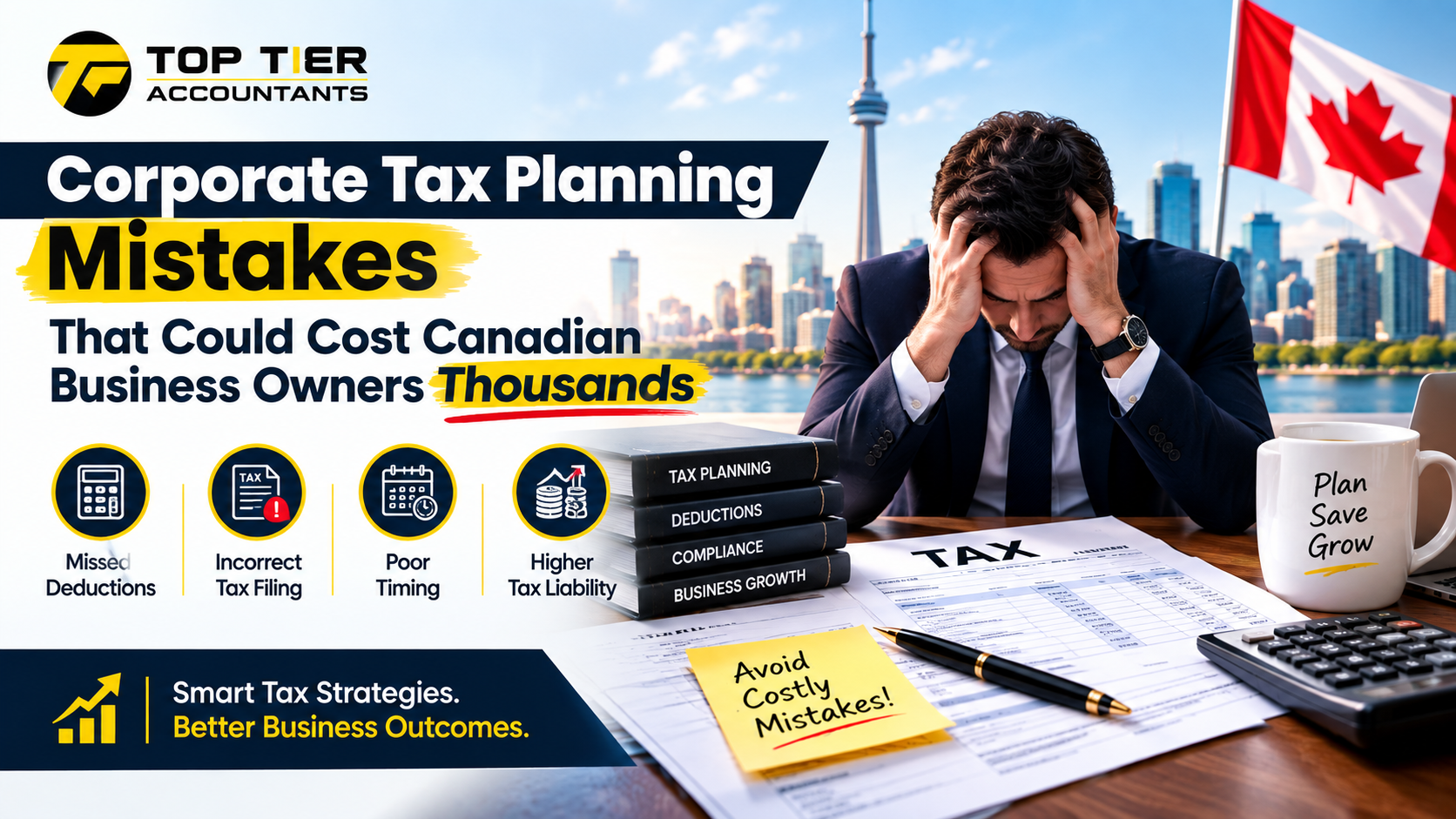
Canadian business owners often focus on increasing revenue, controlling expenses, and finding new customers. Tax planning, however, can have just as much impact on the money a business ultimately keeps. A seemingly small corporate tax planning mistake—such as missing an instalment, overlooking a deduction, or failing to plan for investment income—can potentially cost thousands of dollars.
For incorporated businesses, tax planning should not be something that happens only when the accountant prepares the T2 return. Good corporate tax planning happens throughout the year, allowing owners to make informed decisions before transactions occur.
The following are some of the most common corporate tax planning mistakes Canadian business owners should watch for.
- Corporate Tax Planning Matters
Corporate tax planning is about more than simply reducing the amount shown on a tax return. It is about understanding how today’s business decisions affect tomorrow’s tax bill, cash flow, shareholder withdrawals, investment strategy, and long-term business growth.
For eligible Canadian-controlled private corporations (CCPCs), the federal corporate tax rate on income eligible for the small business deduction is currently 9%, compared with a 15% federal general corporate tax rate. Provincial and territorial taxes apply separately.
That difference alone demonstrates why classification and planning matter.
A business earning substantial profits may have opportunities to manage when and how income is earned, expenses are incurred, assets are purchased, and money is withdrawn. But these decisions need to be based on the actual rules—not aggressive assumptions.
The biggest tax savings often come from planning before year-end, rather than trying to fix mistakes after the return has already been filed.
Mistake #1 – Waiting Until Tax Season
One of the most expensive mistakes is treating the accountant as someone who only becomes involved after December 31.
By tax season, many planning opportunities have already disappeared.
If a corporation is expecting significantly higher income, for example, the owner may want to review estimated taxes, instalments, equipment purchases, compensation strategy, investment income, and available deductions before year-end.
A proactive review can also identify unexpected issues. Perhaps the company has generated more investment income than expected. Perhaps a major asset purchase needs to be reviewed for its tax treatment. Perhaps the corporation’s instalments are too low.
Tax planning works best before the transaction—not after it.
Mistake #2 – Ignoring Corporate Tax Instalments
Corporations generally have to pay income tax through monthly or quarterly instalments, although specific exceptions apply. CRA states that corporations are responsible for calculating their own instalments and does not send corporate instalment reminders.
This is an important distinction for business owners who assume CRA will remind them when a payment is due.
Late or insufficient instalments can result in instalment interest, and CRA compounds this interest daily. In certain circumstances, an additional instalment penalty can also apply when the instalment interest exceeds $1,000.
Business owners should therefore review their expected corporate tax liability during the year rather than simply paying last year’s instalment amount without considering current performance.
Mistake #3 – Missing Legitimate Business Deductions
Another costly mistake is failing to identify legitimate business expenses.
A corporation may have deductible costs relating to advertising, professional fees, office expenses, insurance, software, supplies, travel, vehicle use, salaries, and other operating activities, depending on the circumstances.
The important point is documentation.
An expense should not be claimed simply because it feels business-related. The corporation should be able to demonstrate the business purpose and retain appropriate records.
Good bookkeeping throughout the year makes this much easier.
Instead of searching through twelve months of receipts at year-end, business owners can maintain organized records continuously and identify potential deductions while the transactions are still fresh.
Mistake #4 – Mixing Business and Personal Expenses
Using a corporate credit card for personal purchases may seem harmless, especially when the business is small.
It can create significant accounting and tax complications.
Personal expenses generally aren’t automatically deductible simply because they were paid through the corporation. Depending on the circumstances, personal amounts may need to be treated as shareholder benefits, shareholder loans, or other appropriate accounting entries.
A better approach is to maintain a clear separation between business and personal finances.
Use dedicated business bank accounts and credit cards, keep receipts, and clearly document transactions.
Clean records don’t just make bookkeeping easier. They also make it much easier to explain transactions if CRA reviews the corporation.
Mistake #5 – Ignoring the Small Business Deduction
For eligible CCPCs, the Small Business Deduction (SBD) can be one of the most valuable corporate tax provisions.
The federal preferential rate is currently 9% on qualifying income within the applicable business limit.
However, business owners should not assume that every dollar of corporate income automatically qualifies.
The type of income, associated corporations, taxable capital, and other rules can affect the available business limit.
For businesses approaching or exceeding the small-business threshold, year-end tax planning becomes particularly important.
Mistake #6 – Overlooking Passive Investment Income
A profitable corporation may eventually accumulate surplus cash.
The owner may decide to invest that money in GICs, bonds, stocks, mutual funds, ETFs, or other assets.
This can be a sensible wealth-building strategy—but it can also create tax consequences.
The passive-income rules can reduce the small-business limit when adjusted aggregate investment income of the corporation and associated corporations falls between $50,000 and $150,000. At $150,000 or more, the business limit can potentially be reduced to zero under the applicable rules.
For a growing corporation, that can mean significantly higher tax on active business income.
This is why corporate investment decisions should be considered as part of the overall tax strategy, rather than separately from the operating business.
Mistake #7 – Poor Salary and Dividend Planning
How should an owner take money out of the corporation?
Salary? Dividends? A combination?
There is no universal answer.
Salary can have implications for personal tax, CPP, RRSP contribution room, and corporate deductions. Dividends have their own personal tax treatment and do not operate in exactly the same way.
The optimal strategy depends on the owner’s income, household situation, corporation, cash flow, retirement plans, and long-term objectives.
Instead of automatically paying the same salary or dividend every year, business owners should consider an annual compensation review.
Mistake #8 – Ignoring Capital Cost Allowance
Businesses often purchase equipment, vehicles, computers, furniture, machinery, and other capital assets.
These purchases generally aren’t treated exactly like ordinary operating expenses.
Capital Cost Allowance (CCA) can allow qualifying capital expenditures to be deducted over time according to the applicable tax rules.
Failing to properly track capital assets can lead to missed opportunities, incorrect calculations, or poor year-end planning.
Before purchasing a major asset solely for a tax deduction, however, consider the economics first.
Spending $100,000 simply to save tax rarely makes financial sense.
The better question is:
“Do I need this asset, and what is the most tax-efficient way to purchase it?”
Mistake #9 – Failing to Plan for GST/HST and Payroll
Corporate tax isn’t the only tax obligation a business owner needs to manage.
GST/HST and payroll remittances can create serious cash-flow problems when they aren’t properly budgeted.
A company may appear profitable while owing significant amounts for payroll deductions or sales tax.
These obligations should not be treated as extra cash available for business spending.
Late payments can lead to penalties and interest, and CRA specifically identifies penalties for late payroll remittances and GST/HST obligations.
A strong tax plan therefore includes cash-flow forecasting, not just income-tax calculations.
Mistake #10 – Not Reviewing the Corporate Structure
As a business grows, its original structure may no longer be appropriate.
A company that started as a simple operating corporation may eventually have multiple shareholders, investments, significant retained earnings, related companies, or plans for expansion or sale.
Associated-corporation rules can affect the allocation of certain tax limits, so simply creating another corporation does not necessarily create another independent small-business limit.
This is why corporate restructuring should be reviewed with a qualified tax professional before assets or shares are transferred.
A structure designed for a $100,000 business may not be ideal for a company generating several million dollars in revenue.
How Top Tier Accountants Can Help
Effective tax planning is about making informed decisions before the tax deadline arrives.
At Top Tier Accountants, Canadian business owners can receive support with corporate tax planning, bookkeeping, financial statements, payroll, GST/HST, corporate tax returns, CRA compliance, and business advisory services.
A year-end planning review can help you examine:
- Expected corporate income
- Tax instalments
- Available deductions
- Small Business Deduction eligibility
- Corporate investments
- Salary and dividend strategy
- Capital purchases
- GST/HST obligations
- Payroll remittances
- Cash-flow requirements
The objective isn’t simply to reduce this year’s tax bill.
It is to build a strategy that supports profitability, compliance, cash flow, and long-term growth.
Conclusion
Corporate tax planning mistakes can become expensive when they are repeated year after year.
Waiting until tax season, underpaying instalments, missing deductions, mixing personal and business expenses, overlooking passive investment income, and failing to review compensation or corporate structure can all create unnecessary costs.
CRA confirms that late or insufficient corporate instalments can result in daily compounded interest, while late corporate returns can also trigger penalties.
The good news is that many of these problems are preventable.
The earlier you plan, the more options you usually have.
For Canadian business owners, a year-end tax review with a qualified accountant can help turn tax planning from a last-minute task into a strategic part of running the business.
Top Tier Accountants can help you review your corporate tax position and plan ahead with greater confidence.
FAQs
1. When should a Canadian corporation start tax planning?
Tax planning should ideally happen throughout the year, with a detailed review several months before the corporation’s year-end. This gives the business time to consider income, expenses, investments, compensation, instalments, and other planning opportunities.
2. Can corporate tax instalments create interest charges?
Yes. CRA states that late or insufficient corporate instalments can result in instalment interest, which is compounded daily.
3. What is the Small Business Deduction?
The Small Business Deduction allows eligible CCPCs to receive a preferential corporate tax rate on qualifying active business income within the applicable business limit. The current federal rate is 9%.
4. Can investment income affect my corporate taxes?
Yes. Investment income can be subject to a different corporate tax regime and, when relevant thresholds are exceeded, can reduce a CCPC’s access to the small-business limit.
5. How can an accountant help with corporate tax planning?
An accountant can review projected income, deductions, instalments, compensation, investments, corporate structure, GST/HST, payroll, and other tax considerations before year-end so the business can make informed decisions.
Disclaimer: This article is for general educational purposes and does not constitute individualized Canadian tax advice. Tax treatment depends on the corporation’s specific circumstances and applicable legislation. Business owners should consult a qualified Canadian tax professional before implementing tax-planning strategies.
Post a comment
Related Posts
September 19, 2026
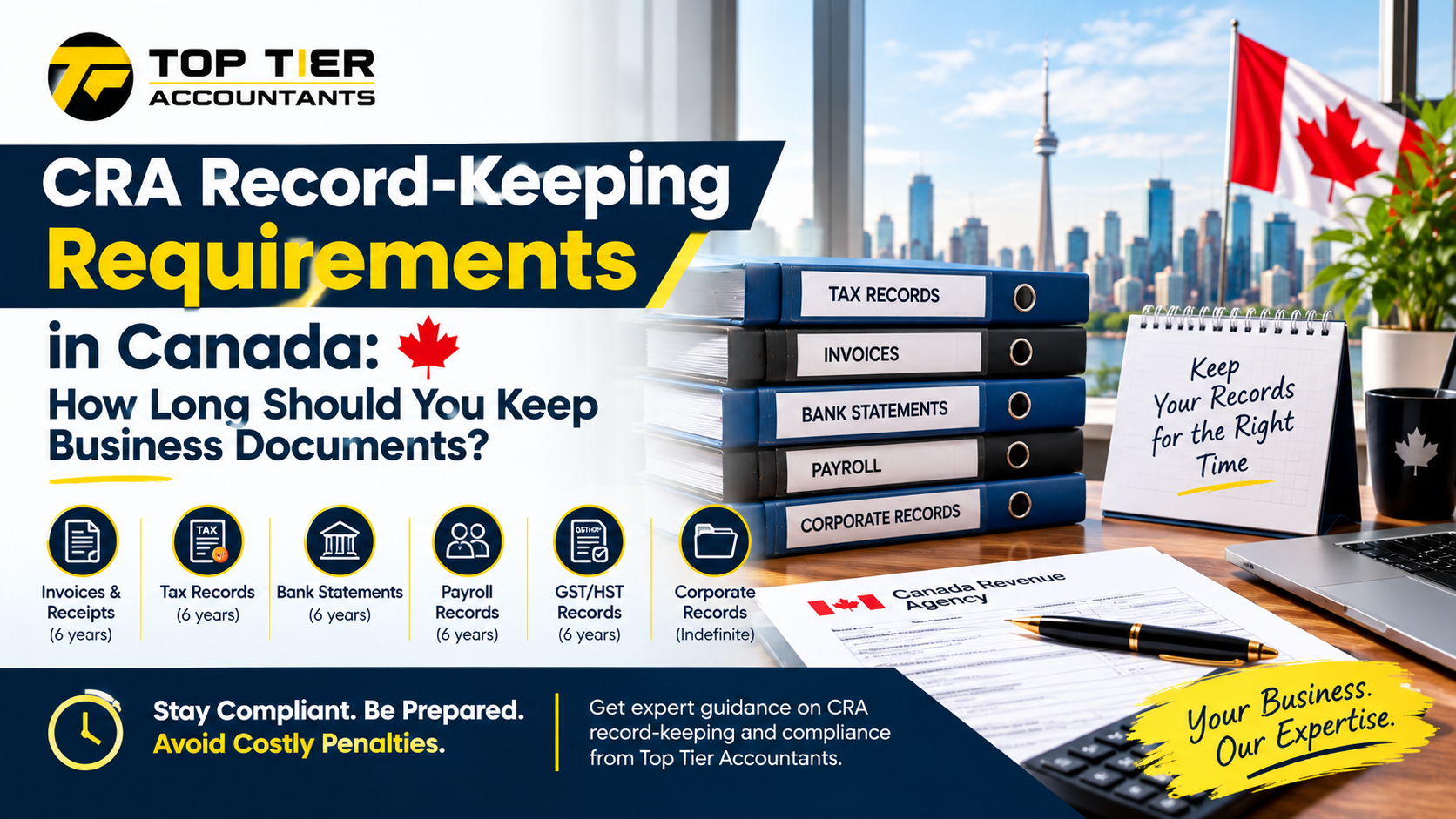
CRA Record-Keeping Requirements in Canada: How Long Should You Keep Business Documents?
Why CRA Record Keeping Matters Good record keeping is one of the most important responsibilities…
September 19, 2026
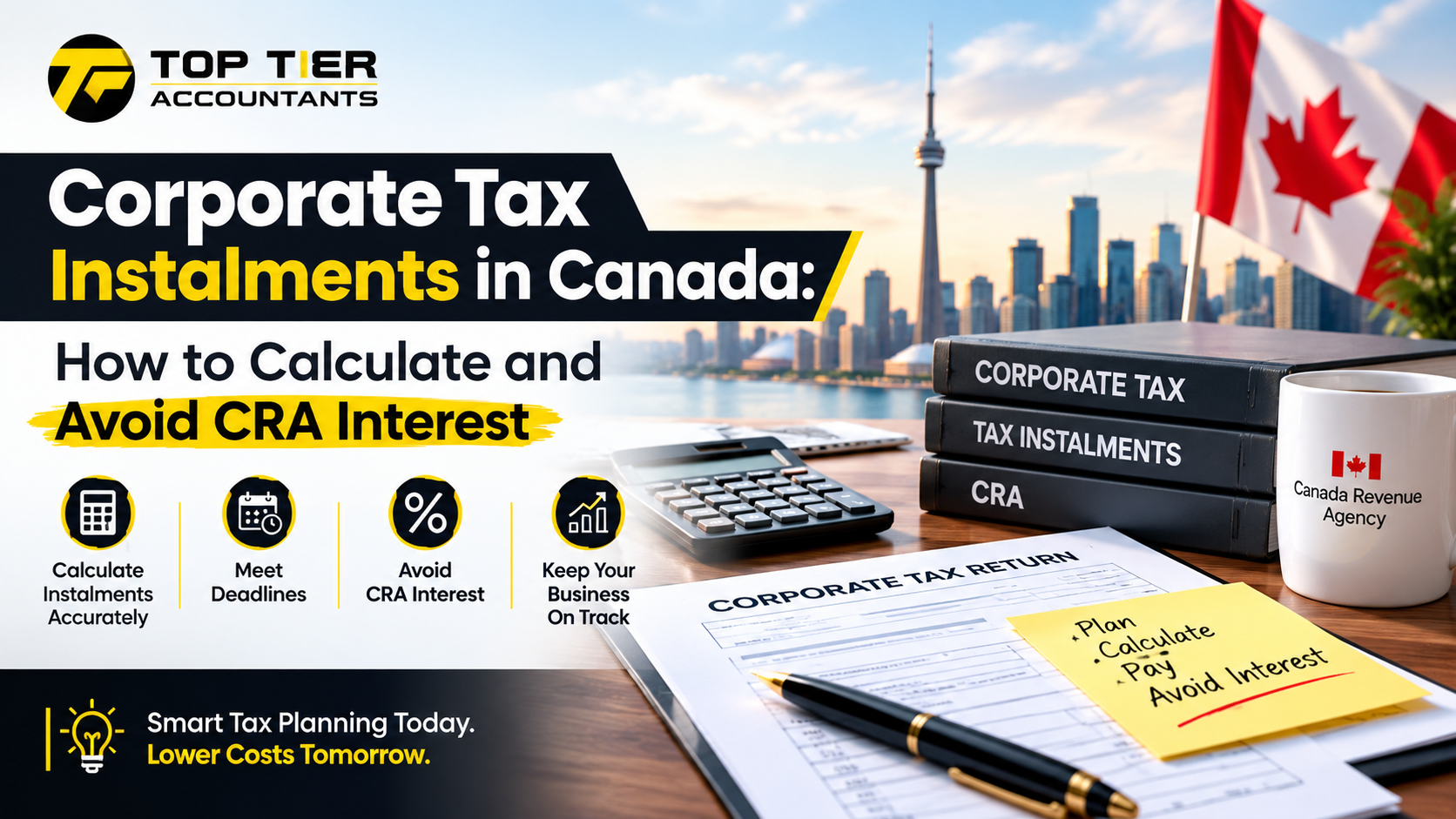
Corporate Tax Instalments in Canada: How to Calculate and Avoid CRA Interest
For many Canadian business owners, corporate tax instalments can feel confusing. You make payments throughout…
September 19, 2026
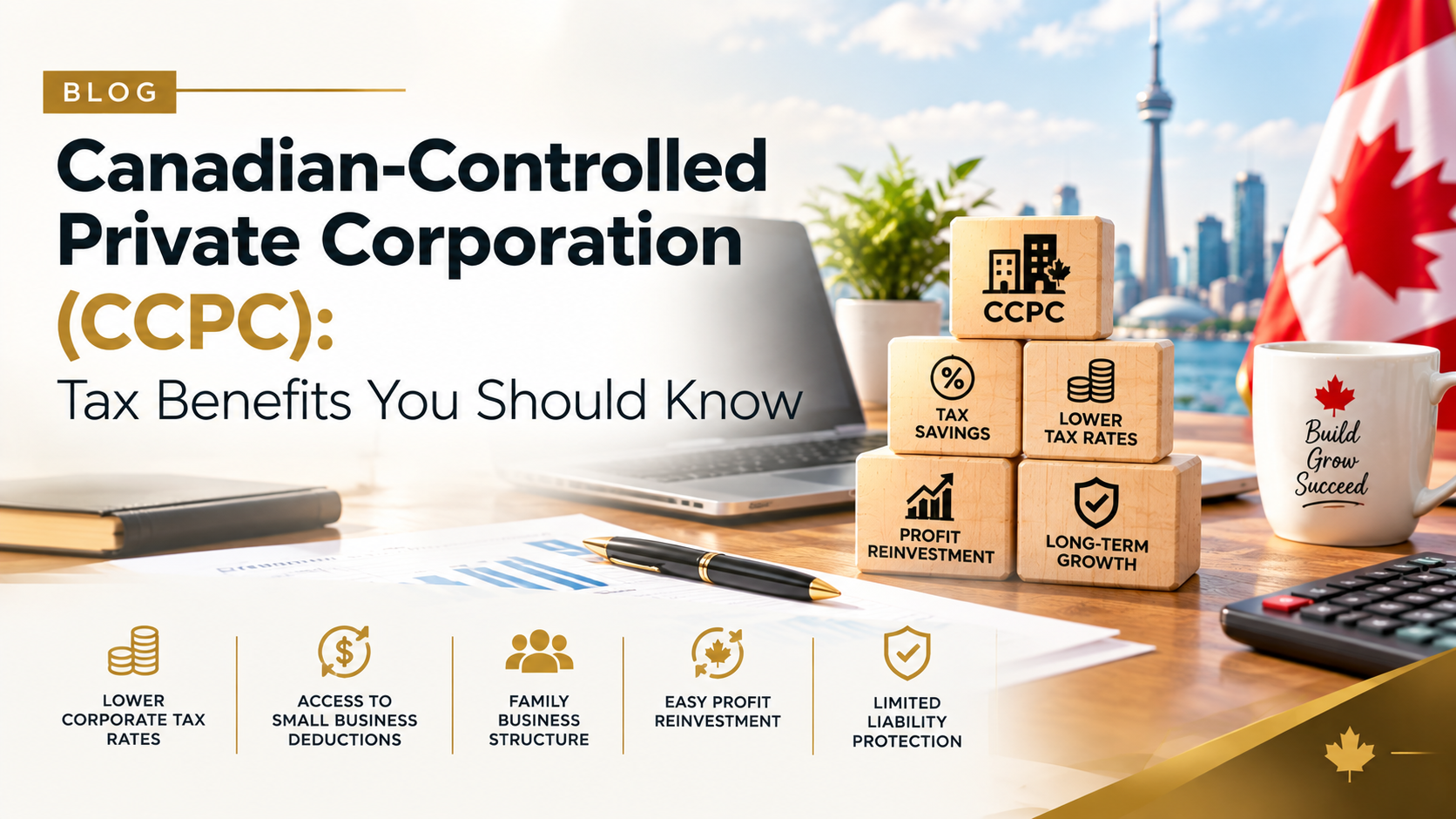
Canadian-Controlled Private Corporation (CCPC): Tax Benefits You Should Know
A Canadian-Controlled Private Corporation (CCPC) can be one of the most valuable structures available to…
September 19, 2026
Business Expenses vs Personal Expenses in Canada: Where Should You Draw the Line?
Running a small business often means your personal and business lives overlap. You might use…