


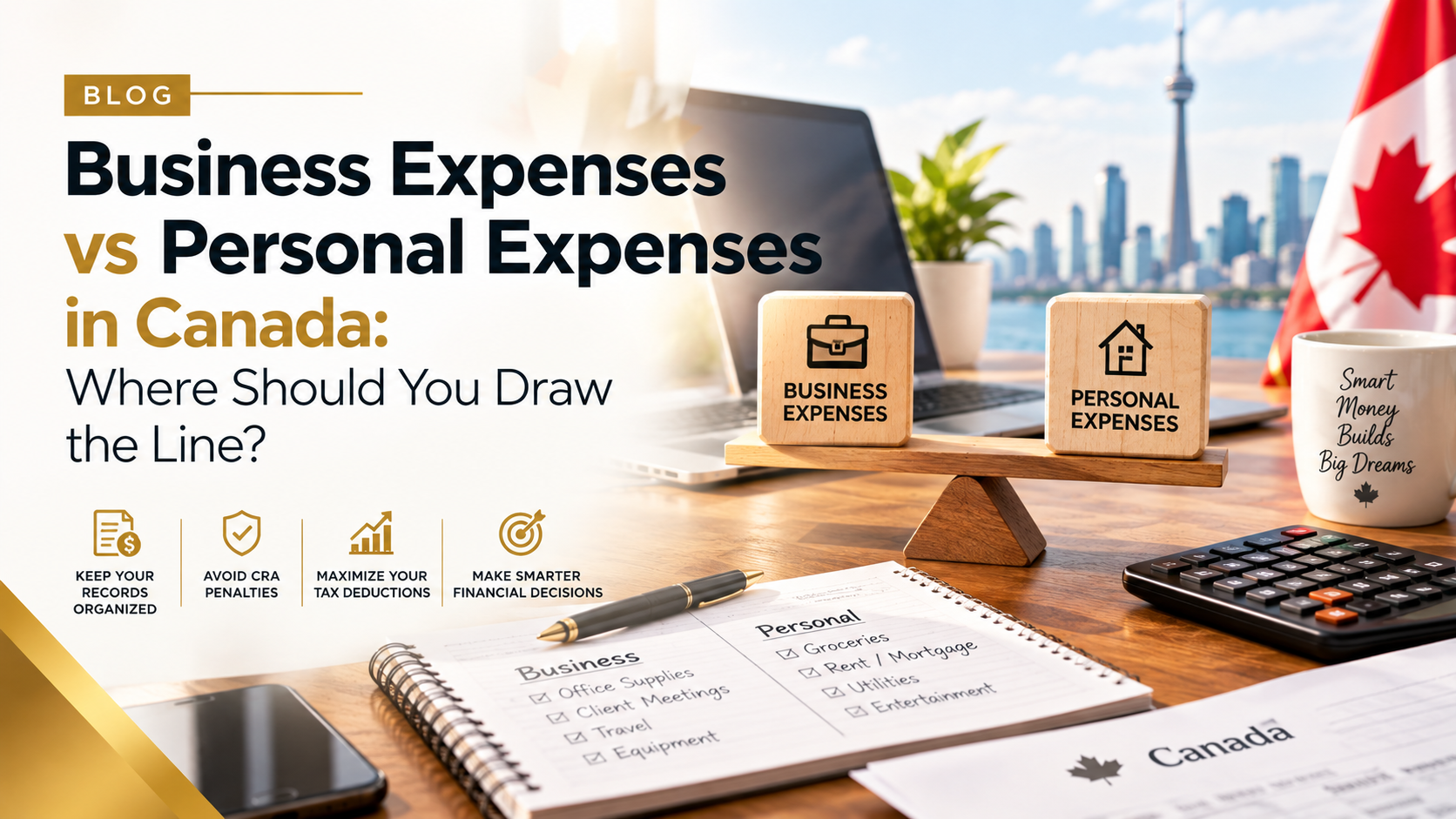
Running a small business often means your personal and business lives overlap. You might use the same vehicle to visit clients and pick up your children from school. You might work from a room in your home, use your personal phone for business calls, or pay for a business purchase using a personal credit card because it was more convenient at the time. These situations are common, but they create an important tax question: which expenses actually belong to the business, and which belong to you personally?
The Canada Revenue Agency’s basic position is straightforward: a business can generally deduct a reasonable current expense incurred to earn business income, but personal expenses are not deductible. When an expense has both business and personal components, generally only the business portion should be claimed.
That distinction matters because claiming a personal expense as a business expense can create problems during a CRA review. It can lead to deductions being denied, adjustments to taxable income, and potentially additional tax, interest, or penalties. For incorporated businesses, there can be another layer: when a corporation pays a shareholder’s personal expenses, the payment may potentially be treated as a shareholder benefit rather than a business expense.
At Top Tier Accountants, the goal is not simply to find expenses you can claim. Good tax planning means knowing where the line is, documenting the business purpose, allocating mixed-use costs properly, and keeping records that can explain every significant transaction.
Why the Difference Matters for Canadian Businesses
Tax deductions can reduce the amount of income on which your business pays tax. Naturally, that makes business owners interested in capturing every legitimate expense. But the word legitimate is doing a lot of work here. An expense does not become deductible simply because it was paid from a business bank account, appeared on a company credit card, or was entered into accounting software under a business category.
The CRA states that businesses should support expense claims with documentation such as invoices, purchase agreements, receipts, or other vouchers. Records should be sufficient to support what was purchased, who supplied it, when it occurred, and how it relates to the business.
This is why expense management is really a documentation and classification exercise. Imagine your bookkeeping as a map. Every transaction should have a clear destination: business expense, capital asset, shareholder transaction, personal expense, or another appropriate category. If everything is thrown into one bucket, your financial statements may look tidy on the surface while hiding a classification problem underneath.
The Basic CRA Rule
The starting point is simple: was the expense incurred to earn business income?
CRA guidance says a reasonable current expense incurred to earn business income can generally be deductible, while personal expenses cannot be claimed.
That does not mean every business-related expense is automatically 100% deductible. Certain expenses have special rules, limitations, or allocation requirements. Capital expenditures, motor vehicle expenses, meals and entertainment, home-office costs, and mixed-use expenses can all require additional analysis.
So instead of asking, “Can I put this through the business?”, a better question is:
“What portion of this expense genuinely relates to earning business income, and what evidence do I have to support that portion?”
What Counts as a Business Expense?
A business expense is generally a cost connected to operating the business and earning income. Examples can include advertising, accounting and legal fees, insurance, business licences, office expenses, salaries, repairs, interest and bank charges, certain travel costs, and other operating expenses depending on the nature of the business.
For example, suppose a plumbing company purchases $500 of advertising on a platform to promote its services. The purpose is directly connected to generating customers and business income, making it fundamentally different from purchasing a personal television for the owner’s home.
Similarly, if a consulting company pays an accountant to prepare its corporate financial statements and tax return, that professional fee is connected to the operation and administration of the business. The key is not whether the owner personally enjoys or benefits from the expense; the key is the business purpose and applicable tax rules.
Reasonable Expenses That Help Earn Business Income
The CRA uses the concept of a reasonable current expense. Reasonableness matters because simply connecting a purchase to the business does not necessarily make the entire amount deductible.
Imagine a small business generating $150,000 of annual revenue. The owner spends $30,000 on an extravagant personal vacation and argues that they answered a few emails during the trip. The fact that some business activity occurred does not automatically transform the entire vacation into a deductible business expense.
Now compare that with a genuine business trip to meet customers, attend a relevant conference, or negotiate a commercial agreement. The circumstances, documentation, and business purpose are very different.
The strongest expense claims are the ones you could explain clearly to an independent person: what was purchased, why the business needed it, who benefited, and how the amount was calculated.
What Counts as a Personal Expense?
Personal expenses are costs associated with your private life rather than earning business income. Groceries for your household, personal clothing, family entertainment, personal vacations, household purchases, and other private costs generally do not become deductible simply because the business owner paid for them.
CRA guidance specifically states that personal and living expenses generally cannot be deducted.
This is where business owners sometimes make an expensive mistake. They see money sitting in a corporate account and think of it as “my money anyway.” But a corporation is a separate legal entity. Corporate funds should not be treated as an unlimited personal wallet.
Why Personal Spending Cannot Simply Become a Business Deduction
Suppose a corporation pays $2,000 for the owner’s family vacation and records it as “business travel.” The accounting entry may look ordinary, but the underlying transaction has not changed. If the trip was personal, calling it a business expense does not change its nature.
For incorporated businesses, the CRA specifically identifies payment of a shareholder’s personal expenses by a corporation as an example of a shareholder benefit.
That can create tax consequences for the shareholder and may also require the corporation to correct its accounting treatment.
Business vs Personal Expenses: A Practical Comparison
| Expense | Usually Business? | Key Consideration |
| Business advertising | Yes | Must relate to the business |
| Personal groceries | No | Personal living expense |
| Business software | Generally | Should be used for business purposes |
| Family vacation | No | Personal unless specific business-related costs qualify |
| Client meeting meal | Potentially | Business purpose and meal rules apply |
| Personal vehicle | Partly | Business-use portion must be supported |
| Home office | Potentially | Specific CRA conditions and allocation rules apply |
| Personal cellphone | Partly | Business-use portion should be reasonable |
| Accounting fees | Generally | Must relate to the business |
| Business equipment | Potentially | May be a capital expense rather than ordinary expense |
The important word in this table is potentially. Tax treatment depends on the circumstances, not merely the label attached to a transaction.
Mixed-Use Expenses
Mixed-use expenses are where many small businesses need the most care. These are expenses that genuinely serve both business and personal purposes.
A vehicle is a classic example. You may drive it to meet customers, attend supplier meetings, purchase business supplies, and visit job sites. You may also use it for groceries, family appointments, vacations, and other personal activities.
The CRA generally allows only the portion of vehicle expenses related to earning business income when a vehicle is used for both business and personal purposes. Supporting records should show the business kilometres and total kilometres driven.
The same basic idea applies to phones, internet, home offices, and certain other shared costs.
Motor Vehicle Expenses
Vehicle expenses deserve special attention because they can be significant. Fuel, insurance, maintenance, repairs, licence and registration fees, eligible interest, and leasing costs can potentially form part of a business vehicle deduction, while CCA is handled separately.
But if the vehicle has personal use, the entire annual cost is generally not simply treated as a business deduction.
Keeping a Proper Mileage Log
Suppose your vehicle travels 30,000 kilometres during the year and 18,000 kilometres are properly documented as business kilometres. The business-use percentage would be:
18,000 ÷ 30,000 = 60%
If eligible vehicle operating costs were $10,000, the business portion based on that percentage would be $6,000, subject to the applicable rules and limitations.
The CRA emphasizes maintaining records of both total kilometres and business kilometres to support the deduction.
A simple mileage log can therefore be far more valuable than trying to reconstruct business travel from memory months later.
Home Office and Home-Based Business Expenses
Working from home does not automatically mean you can deduct a portion of every household bill. CRA rules specify conditions for claiming business-use-of-home expenses.
For example, a self-employed individual may generally qualify where the workspace is the principal place of business, or where the space is used exclusively to earn business income and regularly and continuously to meet clients, customers, or patients.
Calculating the Business Portion
Suppose a home has 2,000 square feet and a dedicated business workspace occupies 200 square feet. A reasonable starting allocation could be:
200 ÷ 2,000 = 10%
If eligible household costs total $20,000, the preliminary business-use portion could be $2,000, subject to the detailed CRA rules and limitations.
If a room serves both business and personal purposes, time-based calculations may also be relevant. CRA guidance explains that the business-use calculation can consider both the area used and, where appropriate, the number of hours the space is used for business.
Meals, Entertainment and Travel
Meals and entertainment can be legitimate business costs, but they deserve careful treatment. Taking a client to discuss a contract is fundamentally different from taking your family to a restaurant and calling the entire bill a client meeting.
A strong record should identify who attended, the date, the location, the business purpose, and the amount spent. That information makes the transaction easier to understand and support later.
Travel creates similar issues. A genuine business trip can involve transportation, accommodation, meals, and other costs, but personal portions should not simply be absorbed into the business expense category.
The question is always: what part of the trip was actually connected to the business?
Documenting the Business Purpose
Avoid vague descriptions such as “meeting” or “business travel” when your accounting system allows more detail.
Instead, record something meaningful, such as:
“Meeting with ABC Construction regarding 2027 commercial contract.”
That small detail can make the transaction much easier to understand months later.
Cell Phones, Internet and Technology
Technology has blurred the boundary between personal and business expenses. A business owner may use one phone for customer calls, social media, banking, family communication, and personal browsing. The same can happen with internet services, laptops, tablets, cloud storage, and software subscriptions.
If an expense is mixed-use, the business portion should be calculated using a reasonable method and supported by records.
A business owner should not automatically claim 100% of a household internet bill simply because they work from home. Likewise, a laptop used primarily for business but occasionally for personal activities may require a different analysis depending on the circumstances and applicable tax treatment.
The safest approach is to establish a consistent allocation method and apply it honestly.
Personal Expenses Paid by a Corporation
This is one of the most important issues for incorporated business owners.
When a corporation pays an owner’s personal bill, the transaction does not become a corporate expense simply because the company paid it. The CRA identifies payments of a shareholder’s personal expenses as an example of a shareholder benefit.
This can happen accidentally. Perhaps the company credit card was used for a family purchase, or the owner paid a personal bill from the corporate bank account and forgot to reimburse the company.
Shareholder Benefits and Tax Consequences
The correct treatment depends on the circumstances, but the important lesson is to identify personal transactions instead of hiding them inside business expenses.
If you discover personal spending in the business account, tell your accountant. It is much easier to correct a transaction during bookkeeping than to discover it years later during a CRA review.
This is also why separate bank accounts and credit cards are so valuable.
Common Expense Mistakes Small Businesses Make
One of the most common mistakes is assuming that every expense paid through the company is deductible. Another is failing to keep receipts because the transaction appears obvious. A third is mixing business and personal purchases on the same credit card and attempting to separate them at year-end.
These habits create unnecessary work and increase the possibility of errors.
Mixing Bank Accounts and Credit Cards
Imagine trying to reconstruct 12 months of business transactions from one bank account containing rent, groceries, fuel, customer payments, subscriptions, family purchases, and business expenses.
It becomes a detective story.
Separate business banking makes the distinction much easier. Personal transactions can still occur accidentally, but they become exceptions rather than the normal operating process.
How to Keep Business and Personal Expenses Separate
A good system does not have to be complicated. Start with a dedicated business bank account and business credit card. Keep digital copies of receipts, categorize transactions regularly, and record the business purpose of unusual purchases.
CRA guidance recommends keeping records such as receipts, invoices, deposit slips, bank statements, and other supporting documents.
A monthly bookkeeping review is much better than waiting until tax season. When transactions are reviewed while they are still fresh, it is easier to remember why a purchase occurred and whether it was business or personal.
For mixed expenses, document the allocation method. For vehicles, maintain mileage records. For home offices, retain the calculations used to determine the business portion.
The objective is simple: make your books tell the truth clearly.
When to Ask an Accountant for Help
Some expense questions are straightforward. Others are not.
If your business has significant vehicle costs, home-office expenses, shareholder transactions, multiple corporations, employees, large equipment purchases, business travel, or mixed personal and corporate spending, professional advice can prevent expensive mistakes.
An accountant can review your books, identify questionable classifications, separate business and personal transactions, and help establish documentation procedures that make future tax filing easier.
At Top Tier Accountants, the focus is not merely on reducing taxes. The objective is to help Canadian business owners maintain accurate books, understand their financial position, and claim legitimate deductions with appropriate documentation.
A good accountant should help you answer three questions:
Is this expense legitimate?
How much of it is business-related?
What documentation supports the claim?
If you can answer those three questions consistently, your expense management becomes much stronger.
Conclusion
The line between business expenses and personal expenses in Canada should be clear even when your personal and professional lives overlap.
The CRA generally allows reasonable current expenses incurred to earn business income, but personal expenses are not deductible. When an expense has both business and personal components, only the appropriate business portion should generally be claimed.
The best protection is not an aggressive deduction strategy. It is good documentation, separate accounts, accurate allocation, consistent bookkeeping, and professional review when the situation becomes complicated.
If your corporation pays personal expenses, don’t simply bury them in an expense category. CRA guidance indicates that payments of shareholder personal expenses can constitute shareholder benefits.
At Top Tier Accountants, Canadian small businesses can receive professional support with bookkeeping, tax preparation, corporate accounting, financial statements, GST/HST, payroll, tax planning, and CRA-related matters.
Claim what you are entitled to. Document what you claim. Keep personal spending personal.
That is where the line should be drawn.
FAQs
1. Can I claim an expense if I use it for both business and personal purposes?
Potentially, but generally only the business-related portion should be claimed. The allocation should be reasonable and supported by appropriate records. Motor vehicle and home-office expenses are common examples of mixed-use costs.
2. Can I pay personal expenses from my corporation?
A corporation may technically make the payment, but that does not make the expense a deductible business expense. CRA guidance identifies payment of a shareholder’s personal expenses by a corporation as an example of a shareholder benefit, so the transaction should be properly recorded and reviewed.
3. Can I deduct my entire car expense if I use my vehicle for business?
Generally, no when the vehicle has both business and personal use. The business-related portion must generally be calculated using appropriate records, including total and business kilometres.
4. Can I claim home-office expenses if I work from home?
Potentially. CRA rules require specific conditions to be met, such as the workspace being your principal place of business or meeting other qualifying conditions. The deductible amount must generally be calculated using a reasonable allocation method.
5. What is the best way to avoid problems with CRA business expenses?
Keep separate business and personal accounts, save receipts and invoices, document business purposes, maintain mileage records where required, reconcile accounts regularly, and ask an accountant about expenses that are unclear.
Post a comment
Related Posts
September 19, 2026
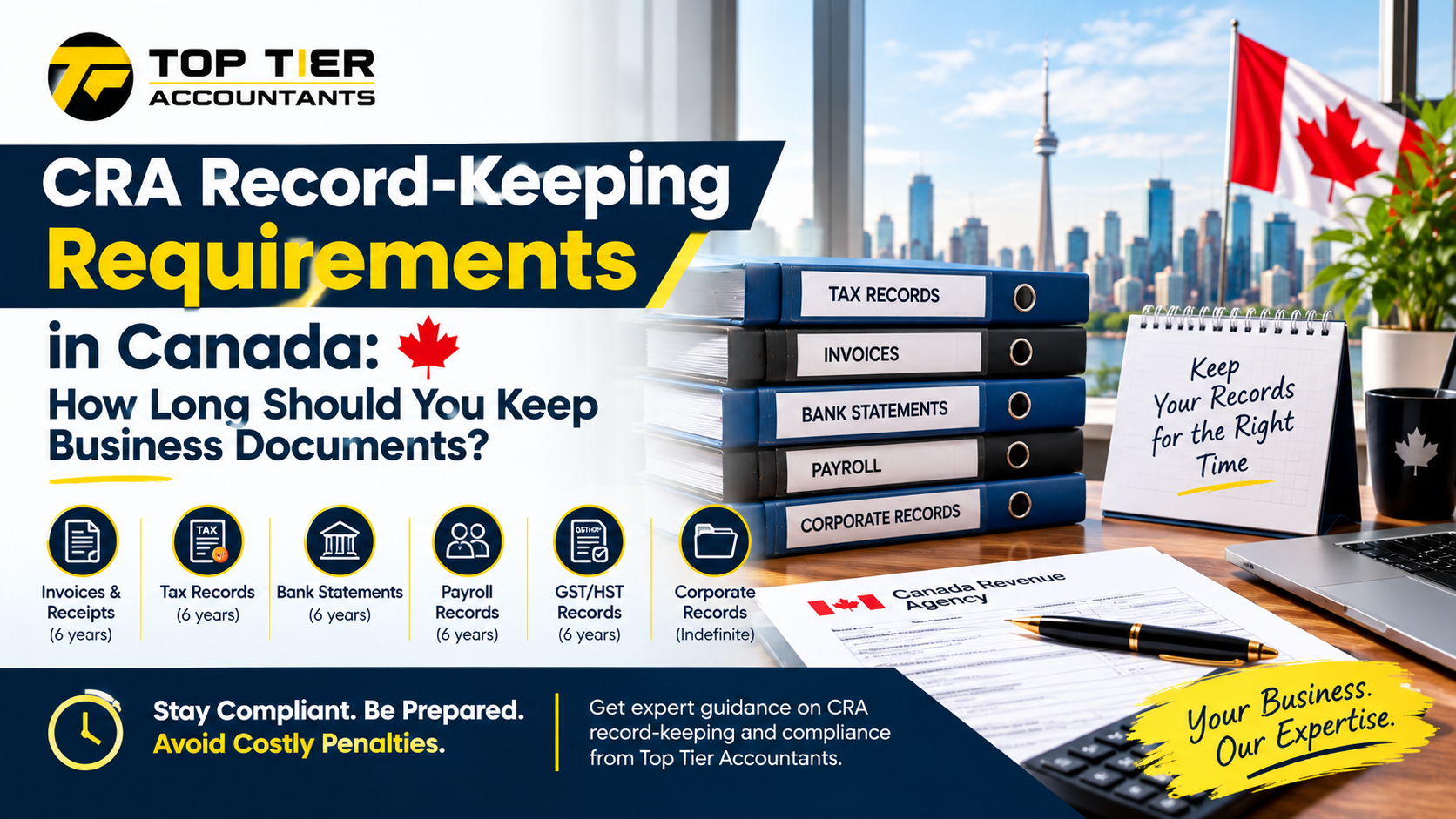
CRA Record-Keeping Requirements in Canada: How Long Should You Keep Business Documents?
Why CRA Record Keeping Matters Good record keeping is one of the most important responsibilities…

September 19, 2026
Corporate Tax Planning Mistakes That Could Cost Canadian Business Owners Thousands
Canadian business owners often focus on increasing revenue, controlling expenses, and finding new customers. Tax…

September 19, 2026
Corporate Tax Instalments in Canada: How to Calculate and Avoid CRA Interest
For many Canadian business owners, corporate tax instalments can feel confusing. You make payments throughout…

September 19, 2026
Canadian-Controlled Private Corporation (CCPC): Tax Benefits You Should Know
A Canadian-Controlled Private Corporation (CCPC) can be one of the most valuable structures available to…