

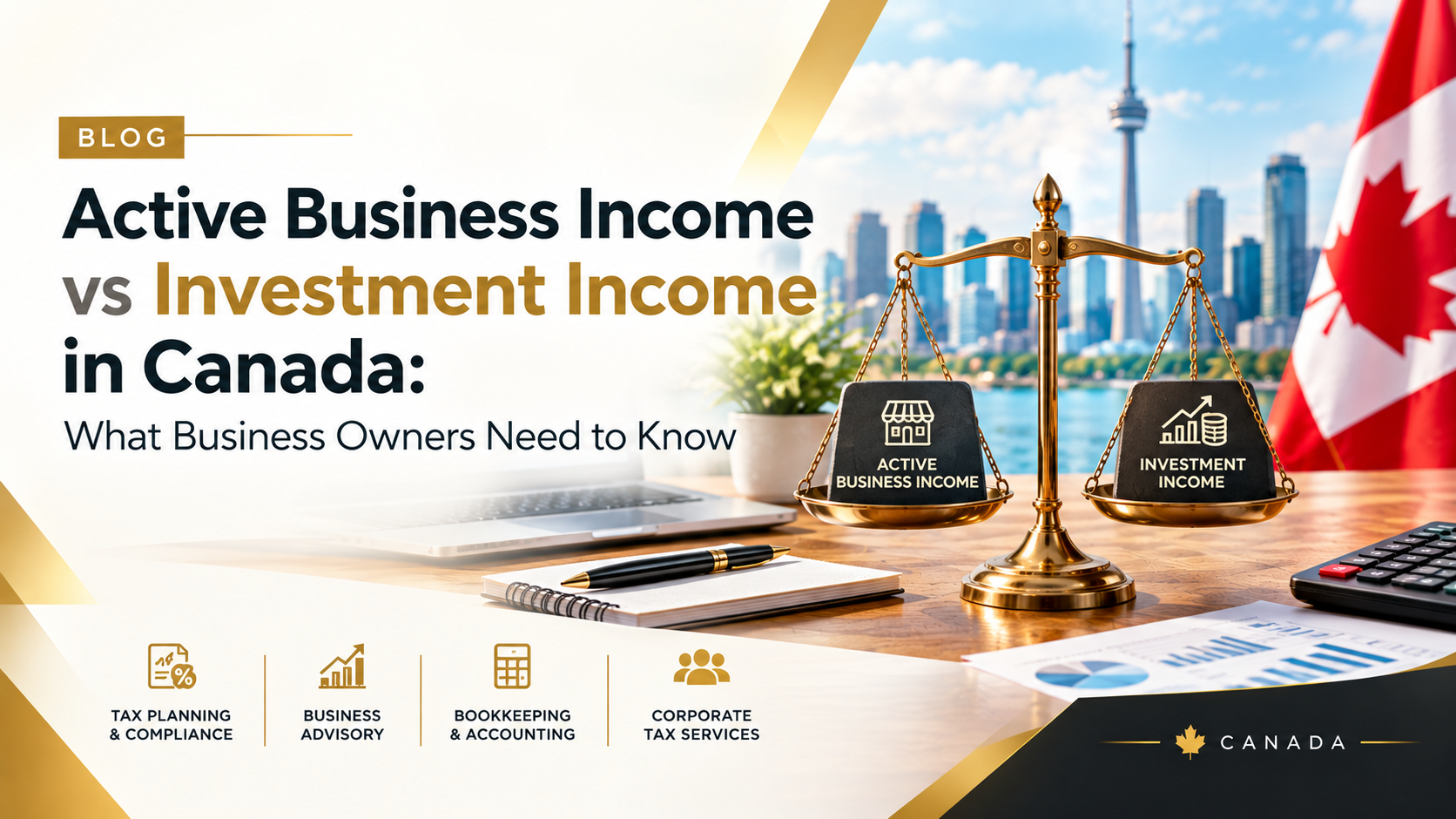
What Business Owners Need to Know
For Canadian business owners, not all corporate income is treated the same way for tax purposes. The distinction between active business income and investment income can affect the corporate tax rate, access to the Small Business Deduction (SBD), the amount of income that qualifies for preferential taxation, and even the amount of tax a corporation may pay in future years.
This becomes particularly important when a successful business starts accumulating cash. At first, the company may simply retain money for payroll, equipment, expansion, or working capital. Eventually, however, an owner may decide to invest some of that surplus in stocks, bonds, GICs, rental properties, or other investments. At that point, the corporation is no longer dealing exclusively with operating income.
The difference can have significant tax consequences.
The federal government currently provides qualifying CCPCs with a 9% federal corporate tax rate on income eligible for the small business deduction, while the general federal corporate rate is 15%. The preferential rate generally applies to up to $500,000 of qualifying active business income, subject to business-limit reductions and other rules.
Investment income is treated differently. In addition to generally being subject to a higher corporate tax burden, investment income can reduce a CCPC’s access to the small business deduction when the corporation and its associated corporations earn enough adjusted aggregate investment income.
For business owners, understanding this distinction is not just an accounting exercise. It can influence how much cash you retain, where you invest it, how you structure corporations, and how you plan for future taxes.
What Is Active Business Income?
Active business income generally refers to income earned from carrying on an active business, such as providing services, selling products, manufacturing goods, construction, professional services, or operating a commercial enterprise. For CCPC small-business purposes, active business income generally excludes investment income and certain other categories of income that receive different tax treatment. CRA materials explain that active business income for the Small Business Deduction generally excludes investment income, rental income, income from a specified investment business, and income from a personal services business.
Think of active business income as money generated because the business is doing business. A plumbing company earns revenue by completing plumbing jobs. A restaurant earns money by selling meals. An accounting firm earns fees by providing accounting services. A construction company earns revenue by completing construction contracts. In each case, the company’s employees, equipment, expertise, systems, and operations are actively generating revenue.
The distinction becomes important because the Canadian tax system is designed to provide qualifying small businesses with preferential taxation on certain active business earnings. The goal is partly to allow businesses to retain more after-tax money for reinvestment, expansion, and job creation. The Department of Finance currently describes the small-business preferential rate as a measure intended to help small businesses retain more earnings for reinvestment and growth.
Examples of Active Business Income
Common examples include:
- Revenue from professional services
- Sales from retail operations
- Restaurant revenue
- Construction income
- Consulting fees
- Manufacturing revenue
- Technology and software development income
- Contracting income
- Landscaping services
- Repair and maintenance services
The exact classification can become more complicated in businesses involving rentals, financing, royalties, investment management, or services provided through corporations.
That is why simply looking at the company’s bank deposits is not enough to determine whether income qualifies as active business income.
What Is Investment Income?
Investment income is generally income earned from property or investments rather than from the corporation’s ordinary operating activities.
Examples can include:
- Interest
- Dividends
- Certain rental income
- Royalties
- Income from investment portfolios
- Certain capital gains
CRA’s T2 guidance explains that aggregate investment income can include income from property and eligible portions of taxable capital gains, subject to the detailed rules and adjustments in the Income Tax Act.
Imagine a corporation that operates a successful consulting business. It has $800,000 sitting in its corporate bank and investment accounts that isn’t immediately needed for operations. The owner decides to invest $500,000 in GICs and securities.
The consulting fees generated from clients are one type of income.
The interest, dividends, and potentially taxable capital gains generated by those investments are another.
That distinction matters because corporate investment income is subject to a different tax framework.
Common Sources of Investment Income
A corporation may earn investment income through:
GICs and term deposits: Interest income earned on corporate cash.
Bonds: Interest payments received by the corporation.
Stocks: Dividends and gains from selling investments.
Mutual funds and ETFs: Distributions and capital gains.
Real estate: Rental income and gains from property transactions.
Private investments: Interest, dividends, or gains from investments in other companies.
The tax treatment varies depending on the specific type of income, the corporation’s circumstances, and whether associated corporations are involved.
Why the Difference Matters for Canadian Corporations
The difference matters because active business income may qualify for preferential corporate tax treatment, while investment income generally does not receive the same small-business treatment.
For a qualifying CCPC, the federal tax rate on income eligible for the Small Business Deduction is currently 9%. The general federal corporate rate is 15%, with provincial or territorial taxes applying separately.
For example, a qualifying Ontario CCPC can potentially benefit from Ontario’s lower corporate tax rate on eligible small-business income. CRA currently lists Ontario’s lower corporate corporate tax rate at 3.2%, producing a combined federal and Ontario rate of approximately 12.2% on qualifying income before considering other adjustments.
Investment income does not simply receive the same preferential rate.
This creates an important planning question:
What should a business owner do with excess cash that the business doesn’t currently need?
Leaving the money in a low-interest corporate bank account may be inefficient from an investment perspective. But investing large amounts inside the corporation without understanding the tax consequences can create another problem.
The right answer depends on the company’s goals.
Active Business Income and the Small Business Deduction
The Small Business Deduction is one of the most important tax advantages available to qualifying Canadian-controlled private corporations.
The federal government currently describes the first $500,000 of annual qualifying active business income earned by a CCPC as being eligible for the preferential 9% federal corporate tax rate, subject to applicable limitations. The $500,000 business limit must generally be shared among associated CCPCs.
This is why business owners often hear the phrase “the $500,000 small-business limit.”
But there is an important catch.
The corporation doesn’t necessarily get the full $500,000 limit regardless of what else is happening inside the corporate group.
The $500,000 Small Business Limit
The business limit can be affected by factors including:
- Associated corporations
- Taxable capital employed in Canada
- Adjusted aggregate investment income
The Department of Finance currently states that the business limit can be reduced where investment income of the associated corporate group is between $50,000 and $150,000, and can be reduced to zero once the relevant investment-income threshold reaches $150,000.W
This means a business owner needs to consider the Entire Corporate Structure, not simply one company’s income statement.
Federal Corporate Tax Rates
For a CCPC claiming the Small Business Deduction, the federal rate is currently 9%.
For corporations paying tax at the general federal corporate rate, the net federal rate is 15%. Provincial or territorial corporate taxes are additional.
| Type of federal corporate taxation | Federal rate |
| CCPC income eligible for SBD | 9% |
| General corporate rate | 15% |
These figures are useful for understanding the basic framework, but business owners should avoid assuming that the final tax bill will simply equal income multiplied by one rate.
Corporate taxation involves deductions, credits, refundable taxes, provincial taxes, business-limit calculations, associated corporations, and the specific type of income earned.
The key takeaway is simple:
Active business income and investment income can produce very different corporate tax results.
How Investment Income Is Taxed
Investment income inside a private corporation is subject to a specialized tax regime.
The policy objective is partly to prevent individuals from gaining a major tax advantage simply by earning investment income through a corporation rather than personally.
For CCPCs, investment income can therefore be subject to refundable corporate taxes. CRA guidance explains that the refundable portion of Part I tax is based on aggregate investment income and foreign investment income, with the calculations performed through Schedule 7 of the T2 return.
The system can feel complicated because some corporate tax associated with investment income may potentially be recovered when the corporation pays taxable dividends to shareholders, depending on the applicable refundable tax accounts and dividend type.
That means the tax calculation shouldn’t be viewed simply as:
“Investment income = permanently high tax.”
Instead, think of it as a separate tax system with corporate tax, refundable mechanisms, and eventual shareholder-level taxation.
Refundable Corporate Tax
Refundable tax is one of the reasons corporate investment income can be confusing.
A corporation may pay a relatively high amount of tax on certain investment income initially, but some of that tax may become refundable under the relevant rules when the corporation distributes certain dividends.
The timing of the dividend therefore matters.
This creates opportunities—and complexities—for tax planning.
Business owners should have their accountant model the corporate tax and shareholder tax together before making major investment or withdrawal decisions.
The $50,000 Passive Investment Income Threshold
One of the most important rules for CCPC owners is the $50,000 threshold.
CRA guidance states that a CCPC’s small business limit is reduced when the CCPC and associated corporations have combined adjusted aggregate investment income between $50,000 and $150,000. Once the relevant investment income reaches $150,000, the business limit can be reduced to nil.
This means a corporation earning substantial operating income needs to pay attention to its investment portfolio.
How the Business Limit Is Reduced
The reduction happens gradually.
The basic idea is:
$0–$50,000 of relevant investment income: No passive-income-based reduction to the business limit.
$50,000–$150,000: The business limit is gradually reduced.
$150,000 or more: The business limit can be reduced to zero under the passive-income rule.
This is a crucial planning issue for corporations that have accumulated significant investments.
Suppose a company has an active business that normally generates $400,000 of qualifying income. If its associated group also generates substantial investment income, the company could potentially lose some access to the small-business rate.
That can increase corporate taxes on active business income.
What Happens When Investment Income Reaches $150,000?
Once relevant investment income reaches the upper threshold, the small-business limit can effectively disappear under the passive-income rules.
The Department of Finance explains that the business limit is reduced when associated-group investment income is between $50,000 and $150,000 and is zero once the investment income reaches $150,000 or more.
This can produce a surprisingly large tax impact.
Imagine two businesses that each generate $500,000 of active business income.
Business A has little investment income.
Business B has a large corporate investment portfolio producing substantial passive income.
The two businesses may not have the same access to the preferential small-business tax rate.
That is why successful business owners should not treat corporate investment income as an afterthought.
A growing investment portfolio can become a corporate tax-planning issue.
Active Business Income vs Investment Income: Key Differences
| Factor | Active Business Income | Investment Income |
| Main source | Operating business | Investments/property |
| Typical examples | Sales, services, contracting | Interest, dividends, certain rents |
| SBD eligibility | Generally potentially eligible | Generally not eligible |
| Federal preferential rate | 9% if eligible | Different investment-income regime |
| Passive-income business-limit impact | Not the trigger | Can reduce SBD limit |
| Main planning focus | Business growth and deductions | Tax efficiency and investment structure |
The important point is not that one type of income is “good” and the other is “bad.”
Both can be valuable.
A profitable corporation may intentionally accumulate investment assets because the owner wants to build long-term wealth.
The issue is understanding the tax cost of that strategy.
Rental Income and Specified Investment Business Rules
Rental income deserves special attention.
A business owner might think:
“My corporation owns a rental property, so the rental profit is business income.”
Not necessarily.
Income from a specified investment business is generally treated differently for Small Business Deduction purposes. CRA explains that a specified investment business is generally a business whose principal purpose is earning income from property, including interest, dividends, rents, or royalties.
There are exceptions.
For example, the rules can permit certain specified investment business income to qualify as active business income where the corporation employs more than five full-time employees throughout the year or where specific associated-corporation service arrangements satisfy the requirements.
This is why a rental corporation with employees and a genuine operating structure can require a different analysis from a corporation that simply owns a few rental properties.
Capital Gains Inside a Corporation
Capital gains can also create confusion.
Suppose a corporation purchases shares for $100,000 and later sells them for $160,000.
The corporation has a $60,000 capital gain.
That gain does not simply become active business income because the corporation is an active operating company.
Capital gains have their own tax treatment.
CRA’s T2 guidance explains that aggregate investment income calculations can include the eligible portion of taxable capital gains, subject to applicable deductions and losses.
This is particularly relevant when a corporation has a large securities portfolio.
A major investment gain can therefore affect not only the tax payable on the investment activity itself but also potentially the corporation’s future access to the small-business limit.
The tax consequences should be reviewed before significant corporate investments are sold.
Should You Invest Excess Corporate Cash?
This is one of the most practical questions for business owners.
Suppose your company has $1 million in the bank.
You only need $300,000 for operating requirements, payroll, taxes, and planned expansion.
What should happen to the remaining $700,000?
Keeping all of it as cash may reduce investment returns.
Investing it may generate additional income but potentially create additional tax and affect the small-business limit.
The answer depends on:
- Expected investment return
- Business cash requirements
- Investment horizon
- Corporate tax rate
- Personal tax rate
- Dividend plans
- Risk tolerance
- Future business expansion
- Corporate structure
- Potential sale of the business
There is no universal “best” answer.
A strong tax plan considers business growth and wealth accumulation together.
Tax Planning Strategies for Business Owners
The first strategy is to separate operating needs from long-term investment capital.
Your business should have enough cash for taxes, payroll, debt obligations, emergencies, and planned growth before investing surplus funds.
Second, monitor investment income throughout the year instead of waiting for the T2 return.
The $50,000 threshold can be significant, so knowing where the company stands before year-end can help with planning.
Third, consider whether a separate corporation could make sense for certain investments. This is not automatically a tax-saving strategy because corporate association rules can still apply, and transferring assets between corporations can have tax consequences.
Fourth, model corporate and personal taxation together.
If the ultimate objective is to move investment wealth to the shareholder personally, corporate tax is only one part of the equation.
Finally, review the company’s structure regularly.
A structure that made sense when the business earned $200,000 may not be ideal when it earns $2 million and holds substantial investments.
Common Mistakes to Avoid
One of the most common mistakes is assuming that all corporate income qualifies for the small-business rate.
It doesn’t.
Another mistake is ignoring investment income until tax season.
By then, the investment income has already been earned and the planning opportunities may be limited.
Business owners should also avoid assuming that creating a second corporation automatically creates another $500,000 small-business limit. Associated corporations generally share the business limit.
Other mistakes include:
- Mixing personal and corporate investments without proper accounting.
- Ignoring the tax treatment of corporate dividends.
- Assuming rental income automatically qualifies as active business income.
- Selling investments without considering the capital-gain consequences.
- Failing to track investment income across associated corporations.
- Making large corporate investments without a long-term tax plan.
- Treating corporate tax savings as permanent personal tax savings.
The most expensive tax mistakes are often made when a business owner focuses on one tax year instead of the next five or ten years.
Working With a Professional Accountant
As a business grows, the difference between bookkeeping and strategic tax planning becomes increasingly important.
A professional accountant can help identify which income is active, which income is investment-related, calculate the company’s available small-business limit, review associated corporations, forecast corporate taxes, analyze investment decisions, and coordinate corporate and personal tax planning.
At Top Tier Accountants, the goal is to help Canadian businesses make informed financial decisions before transactions happen—not simply record them afterward.
A year-round review can cover:
Active business income: Is the company maximizing legitimate deductions and available SBD opportunities?
Investment income: How much passive income is being generated?
Business limit: Is investment income affecting the company’s access to the preferential rate?
Corporate investments: Are the investment strategy and tax consequences aligned?
Cash flow: How much money should remain available for business operations?
Owner withdrawals: Would salary, dividends, or retained corporate earnings better fit the owner’s goals?
Corporate structure: Are associated corporations creating unintended tax consequences?
These questions can help turn accounting data into a practical business strategy.
Conclusion
Understanding active business income vs investment income in Canada is essential for incorporated business owners, particularly those operating through a Canadian-Controlled Private Corporation.
Active business income may qualify for the Small Business Deduction, which currently provides a 9% federal corporate tax rate on qualifying income within the applicable business limit. The general federal corporate rate is 15%.
Investment income follows a different tax framework and can trigger refundable corporate taxes. More importantly for many successful CCPCs, adjusted aggregate investment income between $50,000 and $150,000 can gradually reduce the small-business limit, potentially increasing the tax payable on active business income.
That doesn’t mean business owners should avoid investing corporate cash.
It means they should invest strategically.
The right approach is to understand how operating income, investment income, corporate tax, personal tax, cash flow, business growth, and long-term wealth planning fit together.
For Canadian entrepreneurs, tax planning should not begin after the year ends. The best decisions are usually made before the income is earned, before investments are purchased, and before major corporate transactions occur.
Top Tier Accountants can help Canadian business owners with corporate accounting, bookkeeping, tax planning, financial statements, payroll, GST/HST, CRA compliance, and year-round business advisory services.
FAQs
1. What is the difference between active business income and investment income?
Active business income generally comes from operating an active commercial business, such as selling products or providing services. Investment income generally comes from property or investments, such as interest, dividends, certain rental income, and taxable capital gains. The two categories can receive different corporate tax treatment.
2. Is active business income taxed at 9% in Canada?
A qualifying CCPC can generally receive the 9% federal small-business tax rate on qualifying active business income within the applicable small-business limit. Provincial or territorial corporate taxes are additional, and eligibility depends on the detailed rules.
3. How does investment income affect the small-business deduction?
For a CCPC and its associated corporations, adjusted aggregate investment income between $50,000 and $150,000 can gradually reduce the small-business limit. At $150,000 or more, the business limit can be reduced to zero under the applicable passive-income rules.
4. Should I keep investments inside my corporation?
There is no universal answer. Corporate investing can be useful for building long-term wealth, but investment income can have additional tax consequences and may affect the small-business limit. The decision should consider corporate and personal taxes, cash-flow needs, investment returns, and long-term goals.
5. Can rental income qualify as active business income?
Generally, rental income is subject to different rules and may constitute income from a specified investment business. However, exceptions can apply in certain circumstances, including where the corporation has more than five full-time employees performing the relevant activities or satisfies specific associated-corporation conditions.
Disclaimer: Canadian tax rules are complex and can change. This article is intended for general educational and informational purposes and should not be treated as individualized tax advice. Business owners should consult a qualified Canadian accountant or tax professional before implementing a corporate tax or investment strategy.
Post a comment
Related Posts
September 19, 2026
CRA Record-Keeping Requirements in Canada: How Long Should You Keep Business Documents?
Why CRA Record Keeping Matters Good record keeping is one of the most important responsibilities…
September 19, 2026
Corporate Tax Planning Mistakes That Could Cost Canadian Business Owners Thousands
Canadian business owners often focus on increasing revenue, controlling expenses, and finding new customers. Tax…
September 19, 2026
Corporate Tax Instalments in Canada: How to Calculate and Avoid CRA Interest
For many Canadian business owners, corporate tax instalments can feel confusing. You make payments throughout…
September 19, 2026
Canadian-Controlled Private Corporation (CCPC): Tax Benefits You Should Know
A Canadian-Controlled Private Corporation (CCPC) can be one of the most valuable structures available to…